About Asota caricae (Fabricius, 1775)
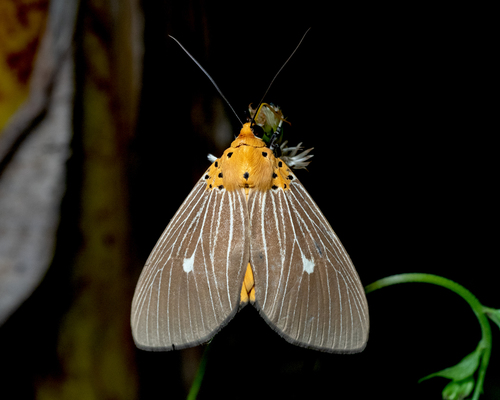
This species has a wingspan of 51 to 58 mm. Its palpi bear black spots on the first and second joints. The forewings are brownish fuscous. A basal orange patch on the forewings contains two subbasal black spots and a series of three spots along its outer edge; the color of this patch matches the scale coloration of the thorax. The forewing veins are streaked with white, and a white spot is present at the lower angle of the discal cell. The hindwings are orange yellow, with a black spot at the end of the discal cell, one additional black spot beyond this, one black spot below vein 2, and an irregular submarginal series of black markings that sometimes forms an almost complete marginal band. The veins that cross this black band are yellowish. The larva is black on its upper side, marked with two dorsal white bands, and bears a sub-dorsal black spot on each somite. A series of lateral black specks is present, and the larva has sparse black hairs. The ventral side of the larva is brown, and the larval head capsule is reddish. Larvae of this species have been recorded feeding on plant species from the genera Ficus, Broussonetia, Mesua, Tectona and Shorea. Pupation takes place inside a slight cocoon that is fixed to a leaf. This species occurs in both forest and agricultural areas.