About Asimina triloba (L.) Dunal
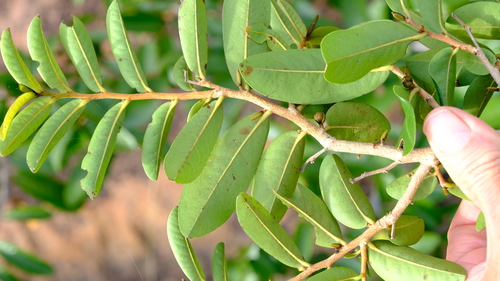
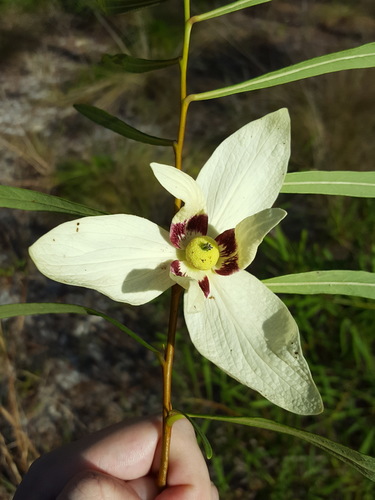
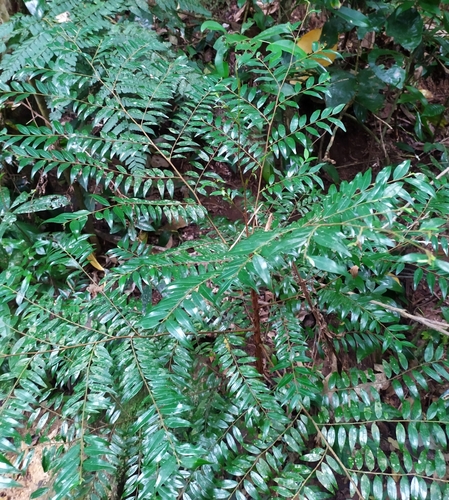
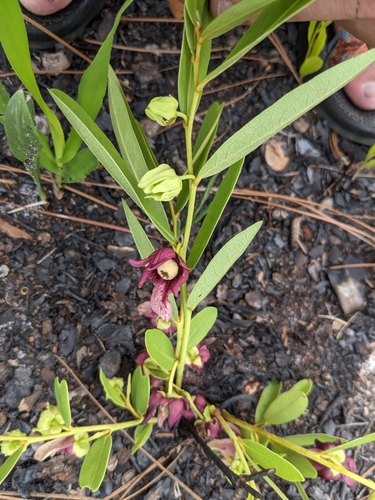
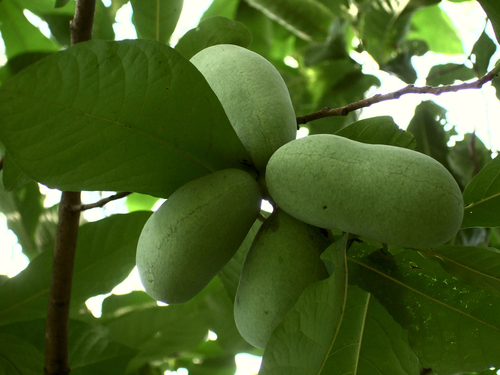
Asimina triloba (L.) Dunol, commonly called pawpaw, is a large shrub or small tree that typically reaches 35 feet (11 meters) in height, rarely growing as tall as 45 feet (14 meters), with trunks 8–12 inches (20–30 centimeters) or more in diameter. Its large leaves cluster symmetrically at the ends of branches, giving the foliage a distinctive imbricated appearance. The large, drip-tipped leaves are more characteristic of tropical rainforest plants than plants in this species' temperate range. Leaves are simple, alternate and spirally arranged, entire, deciduous, and obovate-lanceolate, measuring 10–12 inches (25–30 centimeters) long and 4–5 inches (10–13 centimeters) broad. They are wedge-shaped at the base, with an acute apex, entire margin, and prominent midrib and primary veins. Petioles are short and stout, with a prominent adaxial groove, and stipules are absent. Expanding leaves are conduplicate, green, covered with rusty tomentum beneath, and hairy above; when fully grown, they are smooth, dark green on the upper surface, and paler beneath. Bruised leaves have a disagreeable odor similar to a green bell pepper. In autumn, leaves turn rusty yellow, making pawpaw groves visible from long distances. Pawpaw flowers are perfect and protogynous, around 1–2 inches (3–5 centimeters) across, and turn rich red-purple or maroon when mature, with three sepals and six petals. They grow singly on stout, hairy, axillary peduncles. Flowers emerge in early spring at the same time as, or slightly before, new leaves, and produce a faint fetid or yeasty scent to attract pollinators. The pawpaw fruit is a large berry that ranges from yellowish-green to brown when mature, measuring 2–6 inches (5–15 centimeters) long and 1–3 inches (3–8 centimeters) broad, and weighing 0.7–18 ounces (20–510 grams). It contains several brown or black seeds 1⁄2–1 inch (15–25 millimeters) in diameter embedded in soft, edible fruit pulp. Fruits start developing after flowering, are initially green, and mature by September or October to green, yellowish green, or brown. Mature heavy fruits bend weak branches downward, and full ripening usually only occurs after the fruit falls naturally, indicating a seed dispersal strategy targeting ground-dwelling rather than arboreal mammals. Additional detailed botanical characteristics include: a calyx of three valvate, ovate, acuminate, pale green, downy sepals in bud; a corolla of six petals arranged in two rows, imbricate in bud, with an acute, erect, nectariferous inner row and a broadly ovate outer row that reflexes at maturity, starting green, turning brown, and finally becoming dull purple or maroon with conspicuous veins; indefinite stamens densely packed on a globular receptacle, with short filaments and extrorse two-celled anthers that open longitudinally; pollen shed as permanent tetrads; several pistils on the receptacle summit, projecting from the mass of stamens, with a one-celled ovary, sessile stigma, and many ovules; light brown branchlets tinged with red, marked by shallow grooves; small winter buds of two types, with pointed leaf buds pressed closely to twigs and round, brown, fuzzy flower buds; light gray bark sometimes blotched with lighter gray spots or covered with small excrescences, split by shallow fissures, with tough, fibrous inner bark that has a very disagreeable odor when bruised; pale greenish yellow wood with lighter sapwood, that is light, soft, coarse-grained and spongy, with a specific gravity of 0.3969 and a density of 24.74 pounds per cubic foot (396.3 kg/m3). The longevity of fruit production in A. triloba is undetermined. Asimina is the only genus native to temperate regions in the otherwise tropical and subtropical flowering plant family Annonaceae. A. triloba has the northernmost range of any species in this family, extending north into southern Ontario, Canada. In the United States, it is native to eastern, southern, and midwestern states, ranging from New York west to southeastern Nebraska, and south to eastern Texas and the Florida panhandle. It has been successfully cultivated as far north as Nova Scotia, Canada, and in multiple regions of Europe and Asia. It typically grows in USDA hardiness zones 5 to 8, though some growers have successfully cultivated it in USDA hardiness zone 4b with careful site selection and protection to offset the shorter growing season. In its natural habitat, pawpaw grows in slightly acidic (pH 5.5 – 7.0), well-drained soils. It typically establishes as part of the understory in the Eastern Temperate Forest (Carolinian Forest) region. It can also be found along floodplains, stream banks, and shaded, nutrient-rich bottomlands, but prefers gently elevated slopes due to its deep taproot. While it is shade tolerant, maximum fruit yields are achieved under full sun with some wind protection. Germinating seedlings are extremely sensitive to full sun and require partial shading during their first one to two years. Pawpaw is sometimes included in ecological restoration plantings, as it has many traits that make it ideal for repairing riparian ecosystems. Its preference for wet soil and tendency to multiply clonally to form dense, well-rooted thickets help protect against erosion and runoff. As a native species, it can be planted on river slopes for erosion control, replacing formerly used introduced invasive species such as non-native bamboo and Amur honeysuckle that are now discouraged or prohibited in the eastern United States. For example, pawpaw was selected for post-industrial forest restoration in southern Michigan to act as a native competitor against dominant invasive Amur honeysuckle and increasing non-native privet. A citizen group in Pittsburgh, Pennsylvania has planted pawpaw for 15 years to restore river slopes in forests previously damaged by industry. In the eastern United States, where large predators are almost entirely absent, pawpaw is one of the few native subcanopy trees whose bark and leaves are too poisonous for deer to browse. This makes it a viable species for forest understory restoration in areas where fragmented landscapes, residential development, and park status prevent hunting as a deer population control measure. The lack of commercial demand for pawpaw timber also protects trees used for ecological projects from potential future harvesting. Pawpaw is self-incompatible, meaning pollen cannot fertilize flowers on the same plant. This, combined with the species' tendency to form clonal patches, can reduce fertilization success. A single patch with many stems may produce no fruit if all stems are genetically identical, and fruitless pawpaw patches have been documented in Ohio. The floral scent of A. triloba is described as yeasty, which is one of several features indicating a beetle pollination syndrome. Other floral traits indicative of beetle pollination include petals that curve over the downward-pointing flower center, and food-rich fleshy bases of the inner petal whorl. This creates a pollination chamber at a depth that only small beetles can access during the initial female-receptive stage of bloom. Like other well-studied Annonaceae species, the shift from the female to male floral stage is delayed, offering beetles a secure, possibly thermogenic residence to feed and mate. Receptive stigmas when beetles arrive, followed by pollen-shedding stamens when pollinators leave, is considered an early form of mutualism between plants and insects that remains dominant in the most ancient flowering plant lineages, including Magnoliids, of which Annonaceae is the most species-rich family. Beetles are the dominant confirmed pollinator for genera and species in the Annonaceae family. However, A. triloba and Asimina parviflora have dark maroon petals, a trait that has led to an alternative hypothesis that carrion or dung flies are their effective pollinators. While no scholarly papers have documented carrion or dung flies as effective pollinators in field observations, this hypothesis is strong enough that some horticultural growers place carrion in pawpaw orchards during bloom. Professional studies on the genus Asimina and its species have warned that it is difficult to determine whether insects observed on or collected from flowers are effective pollinators or just casual opportunistic visitors. A 2021 citizen science pollinator watch project in southern Michigan used natural history observation, video, and photo documentation to study pawpaw pollination. The project reported two species of tiny sap beetle were the most abundant and consistently present insects deep within flowers, making them the most likely effective pollinators. These species are Glischrochilus quadrisignatus and Stelidota geminata, both in the family Nitidulidae. Clemson University describes nitidulid beetles as likely night-flying pollinators of pawpaw. The citizen project also documented both larval and adult stages of Glischrochilus quadrisignatus on rotting fruit on the ground in a Michigan pawpaw orchard after harvest, which aligns with scientific reports on well-studied pawpaw relatives such as cherimoya and other valued fruits of the subtropical genus Annona. Because these beetle pollinators are not strong fliers, their full lifecycle must be supported on site in both orchards and forest restoration settings. Abundant leaves, rotting fruit, and other organic matter on the ground near flowering trees are crucial for the beetles' larval stage. Beetles lay eggs there, larvae hatch and feed on decaying matter, then dig down into the soil to pupate over winter, emerging when flowering begins the following year. The bark, twigs, leaves, and seeds of pawpaw have long been assumed to be poisonous to humans, as they are not consumed by native vertebrate animals. Despite this, some herbal concoctions have included pawpaw leaf tissue. Laboratory research that isolated annonacin in pawpaw fruit led to speculation that this compound may be a neurotoxic factor causing atypical parkinsonism. One study reported low concentrations (approximately 70 micrograms per gram) of annonacin in frozen pawpaw pulp, but it is unclear whether this concentration is affected by the freezing process, the cultivar used, or the fruit's maturity stage. A 2015 study cautioned that some standard toxin isolation methods also isolate toxin isomers, which inflates reported toxic concentrations in fruit pulp. Because it is reproductively disadvantageous for fruit skin and pulp to attract coevolved mammalian herbivores before seeds are fully ripe, unripe fruit would be expected to contain toxins or other repellents in its skin and pulp. For this reason, analysis of pulp nutrition and chemicals must be limited to fully ripe fruit. While consumption of annonacin-containing plant products has been linked to atypical parkinsonism, the populations most at risk are those that consume large amounts of Annonaceae fruit products year-round. Specifically, there is concern that pulp from tropical Annonaceae fruits may have caused atypical parkinsonism on the Caribbean island of Guadeloupe and the Pacific islands of Guam and New Caledonia. At the same time, researchers have investigated whether consumption of roots from tropical cycad plants native to these islands may be the primary cause of the neurodegenerative disease. Pawpaw grows best when cultivated in hardiness zones 5-9, and trees take 7–8 years from seedling to produce fruit. Cross-pollination between at least two different genetic varieties is recommended. Until recently, there was insufficient research for horticulturists to develop best methods for attracting insect pollinators, because effective pollinators had not been distinguished from casual insect visitors. As a result, some growers use hand pollination or pollinator attractants such as spraying fish emulsion or hanging chicken necks or other meat near open flowers to attract carrion-feeding beetles. A 2021 citizen science project concluded that tiny beetles are the effective pollinators of pawpaw, with additional details in the pollination section above. Pawpaw has not been cultivated for fruit on the same scale as apples or peaches, primarily because pawpaw fruits ripen to fermentation soon after picking, and only frozen fruit stores and ships well. Other preservation methods include dehydration, making jams or jellies, and pressure canning using the same processing parameters as bananas. Methods to separate seeds from pulp are still experimental. Mechanical methods are the most efficient, but any damage to seeds can contaminate the remaining pulp with seed poisons. Commercial pawpaw production is generally less intensive than production of other fruit trees, as pawpaw requires very little pesticide or herbicide even when planted as a monoculture. Thanks to its long taproot, it grows well even in drier upland plantings. Cultivation of pawpaw for fruit production has drawn interest, especially from organic growers, as a fruit with few to no pests that can be grown successfully in its native environment without pesticides. Commercial cultivation and harvesting of pawpaw is most established in southeastern Ohio, and is being explored in Kentucky, Maryland, and various areas outside the species' native range including California, the Pacific Northwest, and Massachusetts. In New York state, due to climate change impacts on traditional fruit crops such as apples and peaches, farmers are exploring pawpaw as a new commercial crop. Shifts in general public perspective toward healthier and more environmentally conscious diets have led to increased interest in pawpaw as food in recent years. Using pawpaw puree as a substitute for other sweeteners and creamers adds micronutrients such as iron and manganese, while typically reducing total sugar content and glycemic index in most recipes. When done correctly, this does not negatively affect the quality of baked goods or desserts. In a study testing pawpaw puree in muffins, pawpaw muffins were preferred over control muffins with sugar and apple puree in blind taste tests. Frozen pawpaw pulp is used in ice cream and smoothies, and some craft brewers use the fruit in sour beers and meads. Pawpaw is also used for landscaping due to its distinctive growth habit, attractive edible fruit, and relatively low maintenance needs once established. As of 2024, global weather changes have caused losses to many American apple and peach crops from cold weather, making pawpaw farming an increasingly favorable alternative due to its resilience to weather fluctuations. Pawpaw fruits are the second largest edible fruit indigenous to the United States, exceeded in size only by squash. The earliest documented mention of pawpaws is a 1541 report from the Spanish de Soto expedition, which found Native Americans east of the Mississippi River cultivating what some researchers have identified as pawpaw. The scientific name Asimina triloba derives from the Powhatan word Assimina, which a Jamestown settler transcribed as "wheat plum" in 1612. The Lewis and Clark Expedition ate pawpaws during their travels, and Thomas Jefferson planted pawpaw at his plantation Monticello in Virginia. Historically, pawpaw was a commonly eaten fruit throughout its native range. After the advent of motor travel and refrigeration, it became less commonly used to the point of obscurity, replaced by other commercial fruits. Despite its very short shelf life, vulnerability to bruising, and inability to fully ripen if harvested early, pawpaw has developed specialty market appeal in some regions of its native range including southern Ontario. Horticulturist Barbara Damrosch describes pawpaw fruit as looking a bit like mango, but with pale yellow, custardy, spoonable flesh and black, easy-to-remove seeds. Wild-collected pawpaw fruits ripen from late August to mid-September across most of their range, and ripen a month later near their northern range limit. They have long been a favorite treat throughout the tree's extensive native range in eastern North America, and are occasionally sold locally at farmers' markets. Pawpaw fruits have a sweet, custard-like flavor somewhat similar to banana, mango, and cantaloupe, which varies significantly by source or cultivar, and contain more protein than most fruits. Nineteenth-century American agronomist E. Lewis Sturtevant described pawpaws as "a natural custard, too luscious for the relish of most people." Ohio botanist William B. Werthner wrote, "The fruit ... has a tangy wild-wood flavor peculiarly its own. It is sweet, yet rather cloying to the taste and a wee bit puckery – only a boy can eat more than one at a time." Fresh pawpaw fruits are commonly eaten raw, either chilled or at room temperature. However, they can only be kept 2–3 days at room temperature, or about a week when refrigerated. This short shelf life, difficulty shipping whole fruits, and the need to remove inedible skin and toxic seeds before processing are primary barriers to pawpaw's success as a commercial fruit. Easily bruised pawpaw fruits do not ship well unless frozen. In regions where pawpaws grow, fruit pulp is also used locally in baked dessert recipes, where pawpaw replaces an equal volume of banana in many banana-based recipes. The sweet, creamy fruit is commonly mixed into ice cream or blended into pancakes and other breads. The tough, fibrous inner bark of pawpaw has traditionally been used by Native Americans and Midwestern settlers to make ropes, fishing nets, and mats, and to string fish. Because the exotic emerald ash borer is destroying black ash trees (Fraxinus nigra) in their native range, a Michigan basketmaker whose ancestors traditionally used this northern ash species has started planting pawpaw seeds as a potential fiber replacement. This planting occurs hundreds of miles north of pawpaw's historically native range, making it an example of assisted plant migration during a period of rapid climate change. Pawpaw logs have been used for split-rail fences in Arkansas. The hard, brown, shiny, lima-bean-sized seeds were sometimes carried as pocket pieces in Ohio. Due to the presence of acetogenins, the leaves, twigs, and bark of pawpaw trees can be used to make an organic insecticide.