About Ashtoret lunaris (Forskål, 1775)
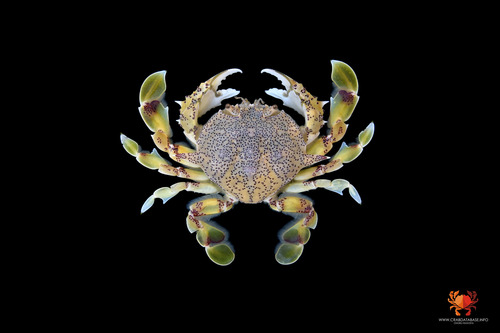
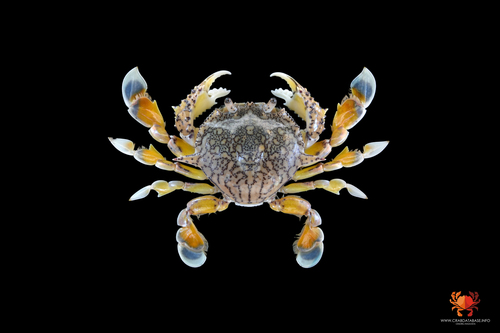
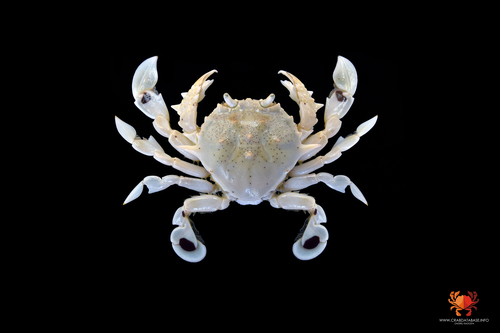
Ashtoret lunaris (Forskål, 1775) has a carapace with a finely grained texture. There are six tubercles in the middle of the carapace's dorsal surface, plus a linear tubercle running along the middle of the carapace's posterior edge. The front of the carapace has straight lobes, with a central lateral and slightly emarginated rostrum. The front lateral margin of the carapace holds five small tubercles, followed by three larger deltoid tubercles. The lateral spine of the carapace is equal in length to one fifth of the total carapace width. On the chelipeds, there is a five-lobed ridge across the middle of the palm; the second and fourth lobes are pointed, and the second lobe is the largest of the five. Males have a finely grained textured ridge on the outer surface of the dactylus, and this ridge is not present in females. The carapace has a beige or yellow background color, covered all over with red dots. The pereiopods end in paddle-shaped tips, which let the species move by skimming along the substrate and burrow rapidly into sand. In some individual specimens, the paddle tips have large dark blotches, and the legs sometimes also have smaller dark spots. Fully grown individuals reach 3–8 cm in total carapace width. This species' native range covers the Indian Ocean and Pacific Ocean, extending from the Red Sea and eastern African coast south to KwaZulu-Natal, east to New Caledonia, south to Australia, and north to Japan. The first recorded specimen of A. lunaris in the Mediterranean was a single individual collected by a trawler at 20 m depth in Haifa Bay in 1987. No additional specimens were recorded in the years after this, and it was assumed any introduced population had died out. In 2015, four female specimens were caught by a trawler in Iskenderun Bay, in southeastern Turkey, which suggests the species has become established in this area. The most probable colonization route is from the Red Sea through the Suez Canal, then along the northward current that runs along the Israel-Lebanon-Syria coast toward Iskenderun Bay. Ashtoret lunaris is fished for food using nets, and this fishery does not occur in Singapore.