About Aseroe rubra Labill.
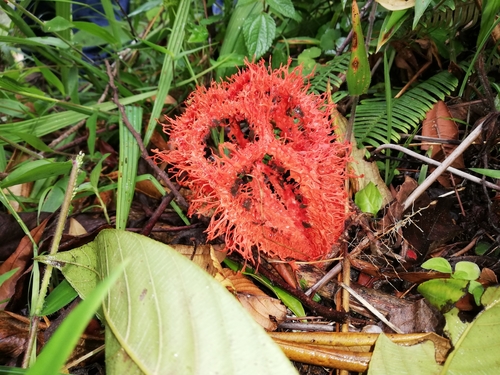
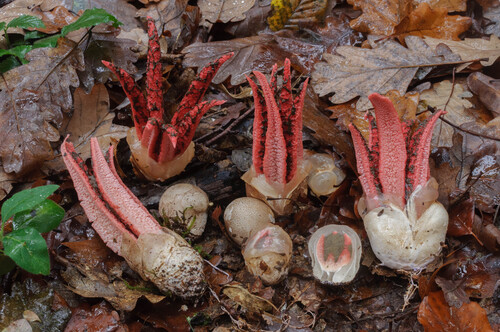
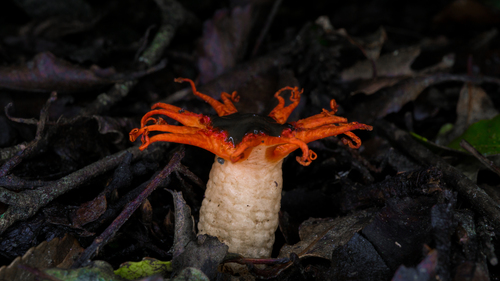
Aseroe rubra Labill. starts as a partly buried, whitish egg-shaped structure 3 cm (1+1⁄4 inches) in diameter. This structure bursts open as a hollow white stalk with reddish arms erupts, growing to a total height of 10 cm (3.9 inches). It matures into a reddish star-shaped structure, with six to ten arms that reach up to 4 cm (1+1⁄2 inches) long and radiate from a central area. The arms are bifid, meaning they are deeply divided into two separate limbs. The upper surface of the fungus is covered in dark olive-brown slime called gleba, which has an odor of rotting meat. A cup-shaped volva, which is the leftover remnant of the original egg structure, remains at the base of the fungus. This fairly common fungus is widely distributed across Australia, ranging from southeastern Queensland through New South Wales, eastern Victoria, and Tasmania. It also occurs across many islands in the Pacific Ocean, including New Zealand. As a saprotroph, it grows on decomposing plant matter, woodchips, and mulch, and is commonly found in gardens and established amenity plantings. It can also be found growing in alpine grasslands and woodlands. It appears to have spread from its original natural habitat to other parts of the world via garden or soil products: it was first recorded growing on soil transported from Australia in a Kew Gardens glasshouse in 1829, and was later found in California, North America. However, transport in garden or soil products cannot explain the species’ presence on remote, uninhabited Pacific islands, or its occurrence in South Africa and the Kenyan village of Kangaita, Kirinyaga, in localities far from any garden. These unconnected, unexplained occurrences cast doubt on the assumption that Aseroe rubra was spread from Australia and New Zealand by human activity. Recently, Aseroe rubra var. zeylanica, which differs from the main species in size (3-4.5 cm diameter) and has salmon pink to reddish-orange unbranched arms or tentacles, has been reported from the Western Ghats region in Kerala, India. This variety grows in semi-evergreen to evergreen forests and Eucalyptus stands at high elevations.