About Asclepias welshii N.H.Holmgren & P.K.Holmgren
Asclepias welshii, commonly called Welsh's milkweed, is a rare species of milkweed. It is native to southern Utah and northern Arizona, where only four known populations of the species remain. The majority of individual plants are located in Coral Pink Sand Dunes State Park, and habitat in many areas here has been degraded by off-road vehicle use. This species is a federally listed threatened species in the United States.
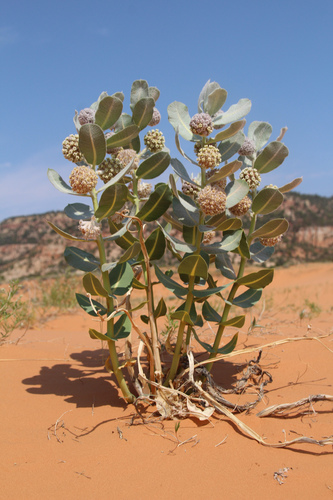
Welsh's milkweed is an erect perennial herb that can grow up to one meter tall. When Holmgren and Holmgren formally described this species in 1979, they called it "a rather handsome milkweed" and noted it is "a very distinctive species with no obvious close relatives." It grows from a sturdy rhizome system that anchors it in the unstable sands of its native dune habitat, with multiple aboveground stems growing from a single rhizome system. Because of this growth pattern, it is impossible to get an accurate count of how many individual plants exist, since several widely spaced stems can belong to one plant. All current estimates of remaining plants are based on stem counts. The rhizomes can penetrate very deep into dunes, possibly reaching the bedrock at the dune base, and all plants in an entire colony may actually be a single individual with cloned stems. Count data records approximately 20,000 stems, belonging to an unknown number of genetically distinct individuals.
This plant colonizes empty dunes, and is eventually outcompeted when other plant species move into the area. It is a pioneer species of blowouts, and often grows alongside blowout grass (Redfieldia flexuosa), a characteristic resident of this habitat type. The upright stem bears several oppositely arranged pairs of leaves, which reach up to 9 centimeters long and 6 centimeters wide. The entire stem and leaves are covered in a dense coat of woolly hairs, with particularly dense hair coverage on new leaves. These hairs may help prevent water loss in the plant's dry habitat, or protect plant tissues from scouring by windblown sand.
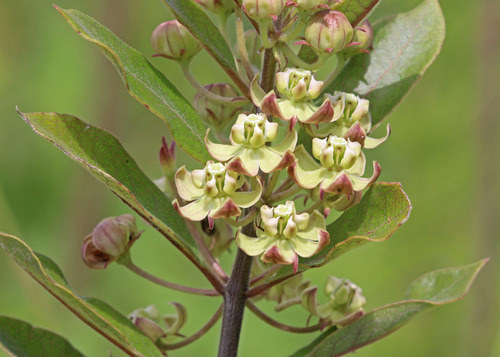
The inflorescence is a dense, round cluster of many flowers, with the entire head measuring around 7 centimeters wide. Each flower is just under 1 centimeter long, white with a pale pink center. The fruit is a warty follicle that holds large hair-tufted seeds that are at least 2 centimeters long. Many plants do not produce many mature fruits, and rely primarily on vegetative reproduction, spreading via their rhizomes.
This plant can be hard to identify when it is not in mature form, as the two immature growth forms look very different from mature plants. The smallest form that emerges through the sand from the rhizome has narrow linear leaves very unlike the broad leaves of the mature plant, and the secondary immature growth form has leaves that fall between the two in shape and size.
The largest population of this plant, located at Coral Pink Dunes State Park (particularly the half managed by the Bureau of Land Management), has been impacted by off-road vehicle use. However, off-road vehicle activity in the area has not increased since this plant was listed for protection, and park staff monitor off-road vehicle activity in the park. Off-road vehicles are not allowed in the Paria Canyon-Vermilion Cliffs Wilderness, which holds another widespread population of the species. The species also occurs south of the Utah border in Arizona. This Arizona population is located on remote, unmonitored Navajo Nation territory, and is not thought to be impacted by human activity.