About Asclepias quadrifolia Jacq.
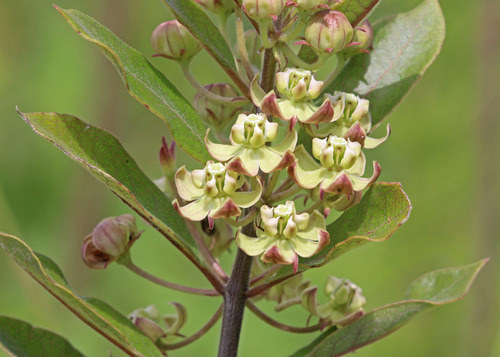
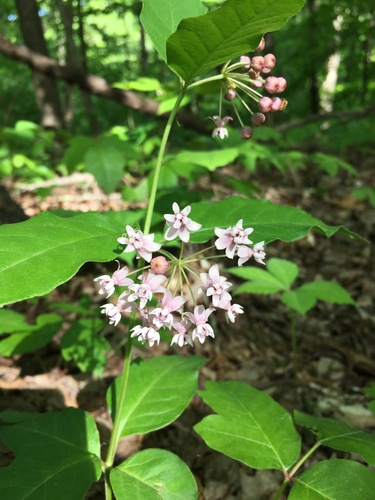
Asclepias quadrifolia Jacq., commonly called fourleaf milkweed, is a perennial herb that grows an upright stem from a fleshy rhizome. Its stem contains milky sap. Compared to other milkweed species, it is small and slender, reaching only 50 centimetres (20 inches) in height. Its leaves are typically elliptic to ovate in shape, measuring 2.5–12.0 centimetres (1.0–4.7 inches) long and 1–6 centimetres (0.4–2.4 inches) wide. Leaves grow in opposite arrangements, with 3 to 4 sets along the stem; one of the upper sets holds 4 leaves arranged in a whorl, which gives the plant its common name, while all other sets only have 2 leaves each. Pale pink to white flowers grow in 1 to 3 rounded, usually pendulous clusters called umbels that emerge from leaf axils and the stem terminus. Its fruit is a follicle (pod) that is very slender, measuring 8.1–14.2 centimetres (3.2–5.6 inches) long and 0.6–0.8 centimetres (.25–.3 inches) thick. The fruit lacks tubercles, and ranges from minutely hairy to glabrous (smooth and hairless). The seeds are broadly oval, up to 0.8 centimetres (.3 inches) long, and have a tuft of white to tan hairs at their tips. In terms of distribution and habitat, A. quadrifolia is native to the United States, where it ranges from Kansas and Oklahoma in the west, to Mississippi and Alabama in the south, and New Hampshire in the north and east. It is listed as an endangered species in Ontario (Canada). Unlike better-known milkweed species such as common milkweed or butterflyweed, fourleaf milkweed lives in woodland habitats. It most often grows in dry, rocky open forest, and is frequently found on upland slopes. For its ecology, flowers bloom from May to July. Insects that feed on nectar from this plant include bumblebees, other bees, wasps, ants, flies, and butterflies. Monarch butterfly caterpillars feed on its foliage. Like most Asclepias species, it is toxic if eaten in large quantities, due to its content of cardiac glycosides and resinoids. Fourleaf milkweed is rare in cultivation.