About Asclepias meadii Torr. ex A.Gray
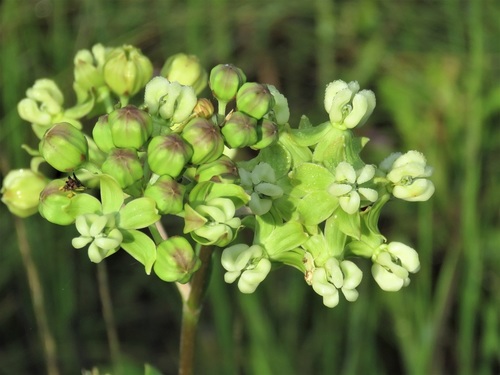
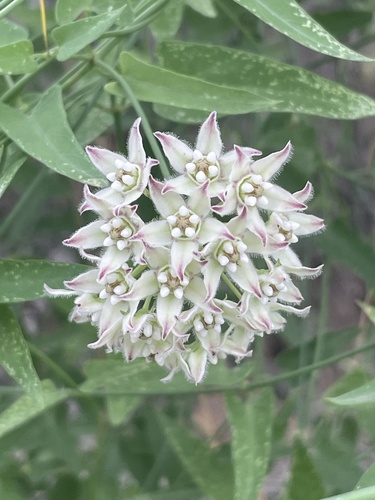
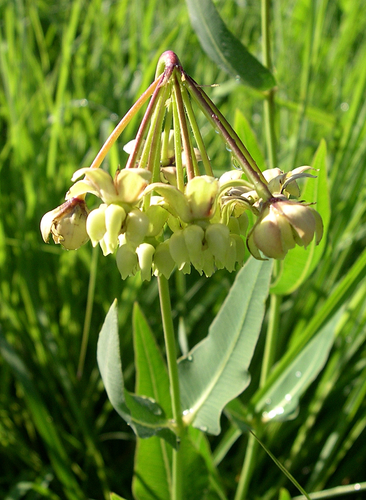
Asclepias meadii Torr. ex A.Gray is a rhizomatous perennial herb that produces a waxy, erect stem up to approximately 40 centimeters tall. Its blue-green leaves, marked with a herringbone pattern, grow in opposite pairs along the stem. The leaves are lance-shaped with smooth blades that sometimes have wavy edges, and reach up to 8 centimeters in length. The inflorescence is a nodding umbel holding between 6 and 23 fragrant flowers. Each flower has five petals up to one centimeter long; new petals are green or purple-tinged, and turn paler as they age. Five reflexed sepals sit behind these petals. The flowers are rich in nectar and are pollinated by digger bees (Anthophora spp.), bumblebees (Bombus spp.), and other bee species. The fruit is a follicle up to 8 centimeters long that contains hairy seeds. This species is long-lived: it takes at least four years to reach sexual maturity, and can live for several decades, possibly over 100 years. The only naturally occurring populations of this plant are found in Missouri and Illinois. Populations have been reintroduced to Indiana and Wisconsin, where the species was previously extirpated. Small populations also exist in Kansas and Iowa, but few of these are likely to persist long-term. This is especially true for Kansas populations, which grow on private hay fields that are mowed frequently. Highway expansions have destroyed populations and habitat of the species, and this issue reemerged in 2019, when a planned highway expansion would destroy some of the plant's remaining habitat. Ecologists have attempted to relocate the affected plants, and this relocation practice has not been effective so far. This species often reproduces vegetatively, sprouting additional new stems from its rhizome. It also sometimes reproduces sexually via seed production. Reduced genetic diversity is a major threat to the species, because it requires genetic diversity to produce robust offspring. Seeds produced from fertilization with low genetic diversity tend to be less viable and grow into weaker plants. This species is also not self-fertile. Human activity has favored vegetative reproduction, which produces clones of existing plants and does not allow genetic remixing. Mowing cuts off flowers or immature fruits, preventing sexual reproduction via seed production. Habitat fragmentation reduces the number of nearby plants available to exchange pollen, and also lowers the chance of visits from common pollinating insects. This plant is adapted to the occasional prairie fires that historically occurred in its habitat, and fire suppression is harmful to the species. Fire provides multiple benefits to the plant, including increased leaf and flower production, and increased genetic diversity. Insect herbivores that feed on this plant include the milkweed beetles Tetraopes femoratus and Tetraopes tetrophthalmus, and the milkweed weevils Rhyssomatus annectans and Rhyssomatus lineaticollis. Like many other milkweed species, Asclepias meadii hosts the monarch butterfly (Danaus plexippus). The non-native oleander aphid (Aphis nerii) greatly weakens milkweed plants by removing sugars from stems and leaves. Infested leaves turn yellow and drop off, and this damage reduces flowering and seed production. The oleander aphid is often just one of multiple insect species that weaken a milkweed plant over a single growing season. A species of parasitic wasp that feeds specifically on Aphis nerii has been approved and introduced for biological control, but no company currently sells this wasp in North America, so the introduced wasp is not widespread. Some other species of aphid-feeding parasitic wasps have been observed to occasionally feed on oleander aphids.