About Asclepias asperula (Decne.) Woodson
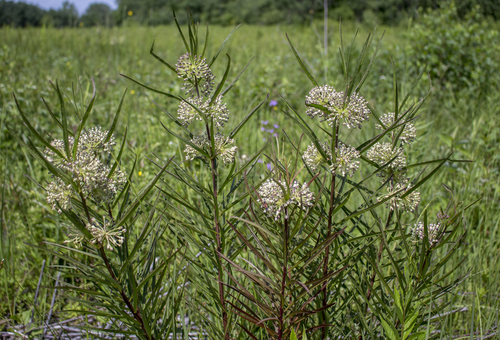
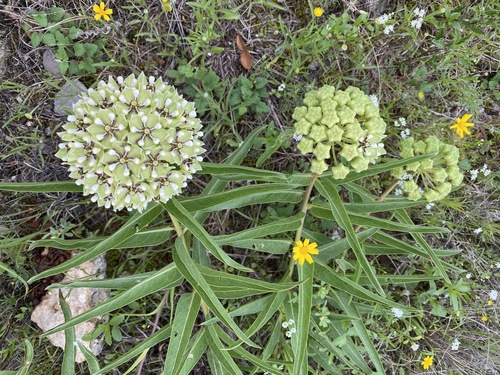
Asclepias asperula, commonly called antelope horns, is a perennial milkweed that grows 0.3–0.9 meters (1–3 feet) tall. It gets its common name from its seed pods (follicles), which resemble antelope horns. It produces clustered greenish-yellow flowers with maroon highlights, and blooms from April through June. These flower clusters are technically umbellate cymes; from a distance, the clusters look like tennis-sized spheres, but they are actually made up of many small green, purple, and white flowers. Each individual flower has 5 pale green petals that cup upward around 5 prominent nectar-storing white hoods. The central circular structure of the flower is a gynostegium, formed by the fusion of 2 stigma and 5 anthers. Unlike many plants, antelope horns does not produce individual pollen grains. Instead, its pollen sticks together into granular masses held in a pollinarium structure, which sits in each of the 5 stigmatic chambers. Each pollinarium consists of two pollinium "wings" connected to a central corpusculum via two translator arms. Pollination occurs when insects visit the flowers to feed on nectar, which is primarily sucrose, accessible at the base of each flower hood. A wide range of insect nectar visitors include bees, butterflies, moths, flies, and beetles. As an insect moves around the flower searching for nectar, one of its legs can slip into a stigmatic slit. To free its leg, the insect must move it upward toward the top of the slit, which can cause the leg to catch on the pollinarium's corpusculum and pull the entire pollinarium out. When the insect carrying this pollinarium visits another milkweed flower, a pollinium may slip into an empty stigmatic slit, become dislodged, and stay in place. If the pollinium is correctly oriented and the surrounding nectar concentration is optimal, pollination will occur. A pollen tube grows from a germination pore on the convex surface of the pollen mass on the pollinium, into the stigma, and down one of the two styles to reach the ovary. Male genetic material from the pollen fertilizes the female ovules, and each ovule can develop into one seed. Asclepias asperula cannot self-pollinate, so it depends on pollinators to transfer pollen between separate plants. Like other milkweeds, cutting antelope horns' stem causes it to bleed white latex sap. This sap, which contains toxic cardiac glycosides (cardenolides), is toxic to some animals and humans. This species is a common milkweed native to Central Texas, and it is easily spotted growing in open meadows. Like several other milkweed species, it is an important host plant and food source for the caterpillars of Monarch and Queen butterflies. Monarch and Queen butterflies retain the plant's toxic cardiac glycosides, which makes the butterflies taste bad and be poisonous to their potential predators, creating an effective defense for the butterflies. It is one of the most important host plants in the southern United States for the generation of Monarch butterflies that develop from eggs laid by Monarchs that have finished overwintering in Mexico. In addition to Monarchs and Queen butterflies, it is also a larval host plant for the dogbane tiger moth and the unexpected cycnia. Because of its toxic cardiac glycosides, Asclepias asperula can be poisonous to livestock and other animals, including humans. This plant is difficult to cultivate and does not grow well in containers. When grown in cultivation, it prefers quickly draining soil that is high in inorganic matter, such as sand and rock chips. It can also grow in loam and clay, as long as it has adequate drainage and frequent dry conditions. Its moisture requirements and tolerance vary depending on its subspecies, and possibly its ecotype. Because it has a deep taproot, it needs the deepest possible container if grown in a pot, and must not be left in waterlogged conditions.