About Ascarosepion pfefferi (Hoyle, 1885)
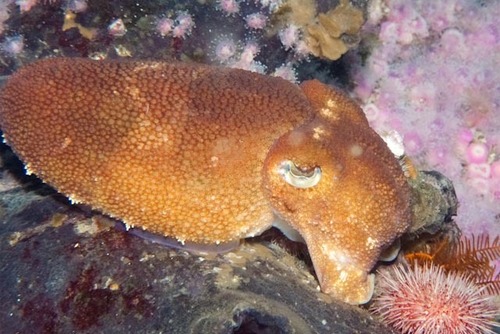
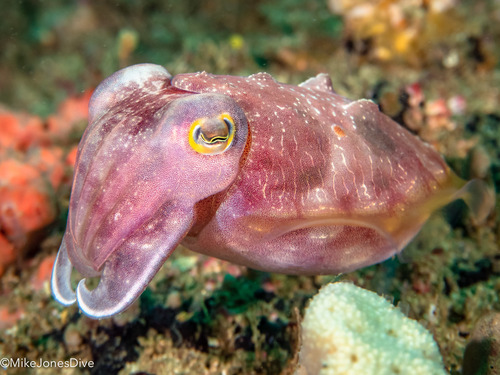
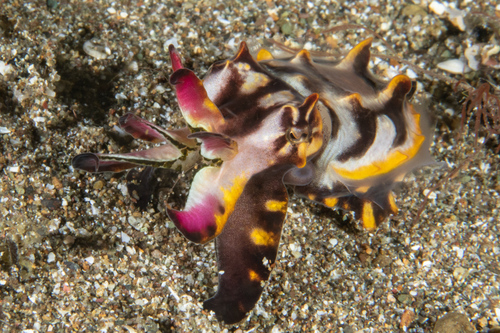
Ascarosepion pfefferi is a robust cuttlefish species with a very broad, oval mantle. Its arms are broad and blade-like, with four rows of suckers. In males, the modified arm used for fertilization, called the hectocotylus, develops on the left ventral arm. The oral surface of the modified hectocotylus region is wide, swollen, and fleshy, and it bears transversely grooved ridges plus a deep furrow that runs along its middle. The sucker-bearing surface of the species' tentacular clubs is flattened, with 5 or 6 suckers arranged in transverse rows. These suckers vary greatly in size, with the largest positioned near the center of the club; three to four median suckers are especially large, and occupy most of the club's middle portion. The swimming keel of the club extends considerably close to the carpus. The dorsal and ventral protective membranes are not joined at the base of the club, but instead fused to the tentacular stalk. The dorsal and ventral membranes differ in length, and both extend near to the carpus along the stalk. The dorsal membrane forms a shallow cleft at its junction with the stalk. The cuttlebone of this species is small, measuring two-thirds to three-quarters of the mantle length, and is positioned in the anterior portion of the mantle. Like other species from the former genus Metasepia, the cuttlebone is rhomboidal in outline. Both the anterior and posterior ends of the cuttlebone taper gradually to an acute point. The dorsal surface of the cuttlebone is yellowish and evenly convex, with a uniformly smooth texture that has no bumps or pustules. A dorsal median rib is absent, and a thin film of chitin covers the entire dorsal surface. The cuttlebone does not have a pronounced spine; any spine that is present is small and chitinous. The striated zone of the cuttlebone is concave, with the last loculus strongly convex and thick in the front third. The sulcus is deep and wide, and extends only along the striated zone. Striae (furrows) on the anterior surface form an inverted V-shape. The limbs of the inner cone are very short, narrow, and uniform in width, with the U-shape thickened slightly toward the back. Unlike the cuttlebone of most other cuttlefish species, the cuttlebone of A. pfefferi does not have an outer cone. As a result, this genus of cuttlefish (which includes A. pfefferi and its sister species A. tullbergi) is the only one known to "walk" across the sea floor. Because its cuttlebone is small, A. pfefferi can only float for short periods of time. Most sources agree that A. pfefferi grows to a mantle length of 8 cm (3.1 in), though other sources report a maximum mantle length of 6 cm (2.4 in). The dorsal surface of the mantle bears three pairs of large, flat, flap-like papillae, and papillae are also present over the eyes. The natural range of A. pfefferi extends from Mandurah in Western Australia, northeastward to Moreton Bay in southern Queensland, across the Arafura Sea to the southern coast of New Guinea. It has also been recorded from Sulawesi and the Maluku Islands in Indonesia, as far west as the Malaysian islands of Mabul and Sipadan, and is common in the Philippines, where it is frequently sighted in the Visayas. A. pfefferi occurs on sand and mud substrates in shallow waters at depths of 3–86 m (9.8–282.2 ft). The species is active during the day, and has been observed hunting fish and crustaceans. It uses complex, varied camouflage to stalk its prey. Its normal base color is dark brown. When disturbed or attacked, individuals quickly change colour to a pattern of black, dark brown, and white, with yellow patches around the mantle, arms, and eyes. The arm tips often display bright red colouration to deter would-be predators. Individuals displaying this colour pattern have been observed using their lower arms to walk or "amble" along the sea floor while rhythmically waving the wide protective membranes on their arms. This behavior is thought to advertise the species' poisonous flesh, but significant amounts of toxins have not yet been isolated from this species. Copulation occurs face-to-face: the male inserts a sperm packet into a pouch on the underside of the female's mantle, and the female then uses the sperm to fertilize her eggs. The female lays eggs singly, and places them in crevices or on ledges of coral, rock, or wood. In one recorded case, around a dozen eggs were found under an overturned half coconut husk, placed there by a female who inserted them through the husk's central hole, which protected the eggs from predatory fish. Freshly laid eggs are white, but slowly turn translucent over time, making the developing cuttlefish clearly visible. When they emerge, A. pfefferi hatchlings are already capable of producing the same camouflage patterns as adults. They are precocial, and receive no parental care after hatching.