About Ascarosepion latimanus (Quoy & Gaimard, 1832)
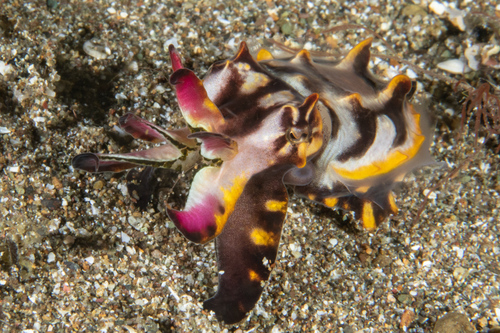
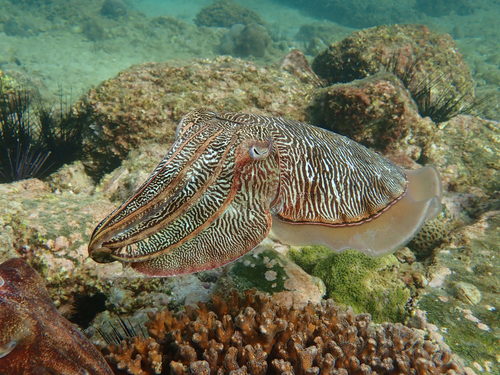
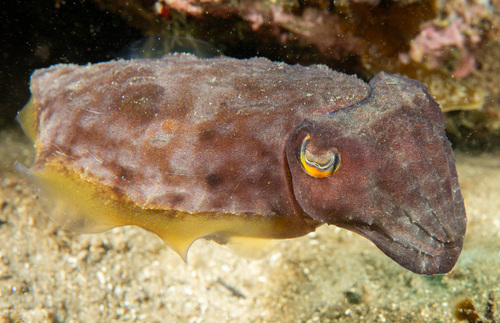
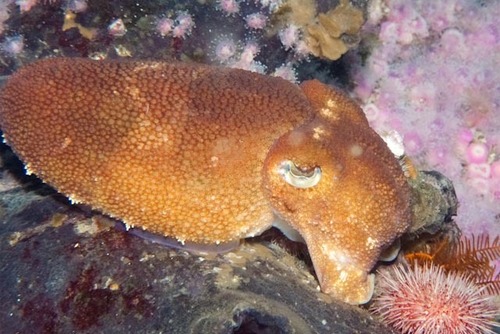
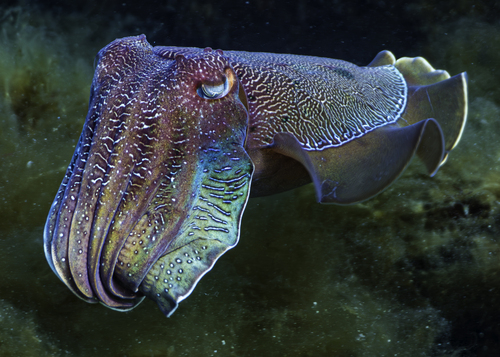
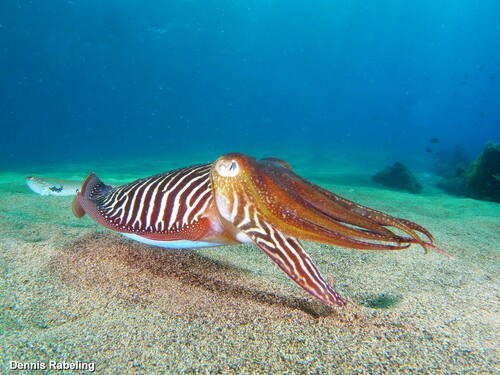
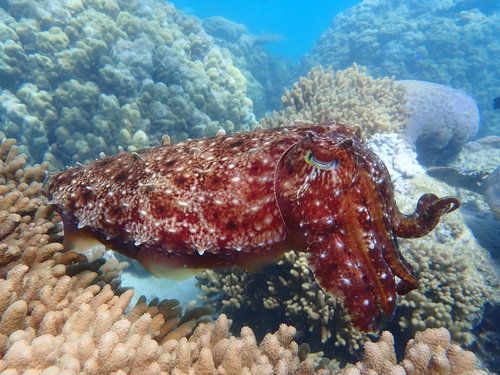
Ascarosepion latimanus, commonly called the broadclub cuttlefish, is the second largest cuttlefish species, only smaller than the giant cuttlefish. Adults reach a mantle length of 50 cm (20 in) and a body weight of 10 kg (22 lb). Like many cephalopods, broadclub cuttlefish can display a wide variety of colors and body textures. Their common base coloration is light brown or yellowish, marked with irregular white mottling. Males sometimes appear dark brown, especially during courtship and mating. Their arms have longitudinal white bands that turn into broad white blotches when the arms are extended. Some arms also have longitudinal brown bands that reach all the way to the head. A saddle-shaped marking dotted with small white and brown spots can sometimes appear on the dorsal mantle. The dorsal mantle also has narrow brown transverse bands, plus bold, white transverse stripes and spots. The area around the ventral margins of the eyes is yellow. The fins are pale, with white transverse stripes that extend onto the mantle, and narrow white bands running along their outer margins. Ascarosepion latimanus has a broad distribution across the Indo-Pacific region. Its range stretches from the coasts of eastern Africa in the west, along continental coastlines through southern Asia, to southern Japan in the north, and as far south as northern Australia and the Coral Sea. Existing records of this species from southern Australia and Madagascar are generally considered to be cases of misidentification. This is a coastal cuttlefish species that lives on coral reefs, found in shallow waters down to a maximum depth of 30 m (98 ft). In the shallower waters of the western Pacific off Guam and Okinawa, breeding occurs between January and May. Eggs laid by this species hatch after 38 to 40 days of development. It is a diurnal species. When hunting, it appears to mesmerize prey using a display of rhythmic color bands that travel along its body. It feeds on fishes and crustaceans, and is known to specifically hunt shrimp and prawns belonging to the genus Palaemon. Breeding males are territorial, and each defends a coral head, most commonly of the genus Porites. Females lay their eggs after mating within the dominant male’s territory. The courtship behavior of this species is highly ritualized and stereotyped, and includes striking visual displays just like its hunting behavior. Males often guard mated females, protecting them from advances by other rival males. Mating occurs with the male and female aligned head-to-head; the male deposits spermatophores into the female’s buccal membrane, located below her mouth. After being laid, the eggs harden and become extremely difficult to remove from the coral the female attached them to. Once they hatch, juvenile cuttlefish hide among coral and coral rubble, where they often mimic mangrove leaves. Their coloration and body posture closely imitate the structure of a mangrove leaf, including a stem shape, leaf ribs, and scattered small black spots.