About Ascarina lucida Hook.fil.
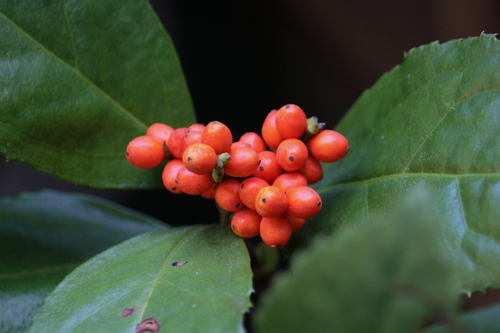
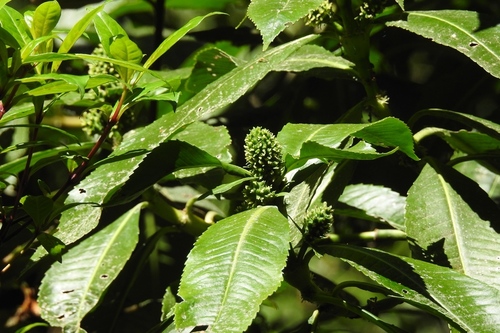
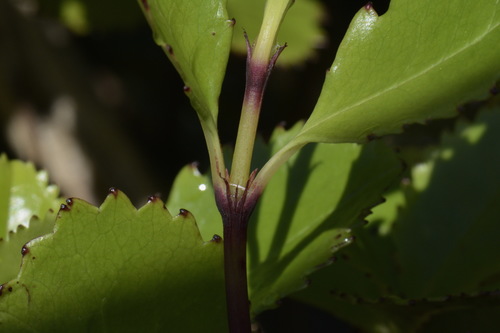
Ascarina lucida, commonly called hutu, is a monoecious species of shrub or small tree. It can grow up to 8 metres (30 feet) tall, with a trunk reaching up to 300 mm in diameter. Its bark is pale and smooth, while its branchlets are slender and dark purple. The wood of Ascarina lucida is reddish-brown, straight-grained, and noted to be tough and strong. The largest known individuals are estimated to have a maximum lifespan of around 130 years. Its leaf petioles measure 8–10 mm long. Leaf blades (laminae) are coriaceous, or leather-like in texture, and measure 20–80 mm long by 15–38 mm wide, with shapes ranging from elliptic to oval to obovate. The leaf surface is glossy yellow-green, rarely dark green, and the leaf serrations are dark purple-black or maroon. Leaf bracts are acute in shape. Ascarina lucida leaves resemble those of pukatea (Laurelia novae-zelandiae), but can be distinguished by the presence of bristles at the base of A. lucida leaves. The inflorescences (flower clusters) of Ascarina lucida are arranged in branched spikes, with individual branches measuring around 30–40 mm long. The flowers are green or red-tinged and 0.8–1.2 mm long. Male flowers bear one cylindrical anther 2.5–3.0 mm long, while female flowers are smaller. The fruit is a fleshy white broadly ovoid drupe 2.5–3.0 mm long, and contains a single seed. Ascarina lucida has a diploid chromosome count of 26. Ascarina lucida is endemic to New Zealand, and occurs across both the North and South Islands. In the North Island it is rare, and occurs mostly on the western side of the island; recorded populations are found in the Bay of Islands, Coromandel Peninsula, Kaitaia, Whangārei, and the Wairarapa Region. In the South Island it is more common, with recorded occurrences in north-west Nelson, Marlborough, and West Coast Regions, and it is abundant on the western side of the island. It grows as far south as Puysegur Point in Fiordland. While A. lucida was common in the early Holocene, it has become progressively less common over the past 7,000 years. Ascarina lucida typically grows in lowland and montane forests. In the South Island, it does not occur at altitudes above 300 m (980 ft), while in the North Island it can grow at altitudes up to 850 m (2,790 ft). In the Auckland Region, it occurs between 20–600 metres (70–2,000 feet) above sea level. It grows in a range of soil types, and is principally found in podocarp-hardwood forests in sheltered sites, and is often found in areas with annual rainfall of 1,500 mm or more. The fruits of Ascarina lucida are dispersed by frugivorous fruit-eating animals such as birds; in 1996, Burrows recorded that silvereyes (Zosterops lateralis) consume large quantities of A. lucida fruit. Ascarina lucida is wind-pollinated, with no confirmed evidence of insect pollination, though the non-native honeybee (Apis mellifera) has been recorded visiting the plant. Moore first studied the floral structure of A. lucida in 1977, which was further investigated by Garnock-Jones et al. in 2025. Ascarina lucida is confirmed to be monoecious, with both male and female flower structures growing on the same individual plant; it was previously incorrectly thought to be dioecious, with individual plants being entirely male or entirely female. In experimental tests of A. lucida's environmental tolerance to different climates, seedlings were exposed to varying temperature, drought, and waterlogged soil conditions. A 2005 study found that A. lucida seedlings can tolerate waterlogged soils, though they develop significantly reduced root biomass under severe waterlogging. Exposure to temperatures of −2°C caused all tested seedlings to die. Ascarina lucida has similar drought tolerance to Coprosma autumnalis, a species known for its drought intolerance. Germination rates for the species vary by the environmental location of the source population, and the species is well-adapted to colonising disturbed sites. A 2002 study recorded a 76 percent germination rate for seeds from submontane populations, compared to a 32 percent germination rate for seeds from lowland populations.