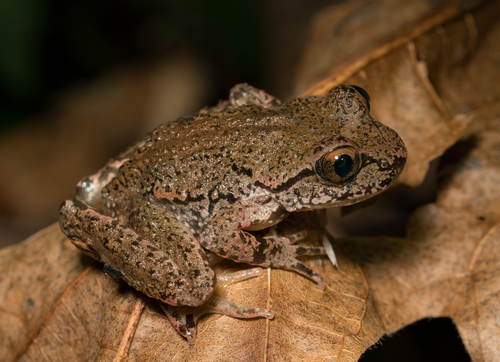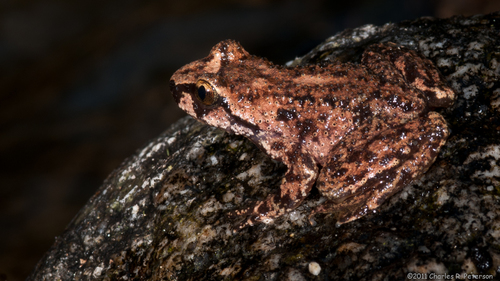
About Ascaphus montanus Mittleman & Myers, 1949
General morphology: What makes this frog family different from all other frogs is the visible "tail" appendage that only males have. This structure is actually part of the male cloaca, used to insert sperm into females during mating. The species typically lives in turbulent, fast-flowing streams, and this anatomical feature reduces sperm loss to improve breeding success, which means tailed frogs use internal fertilization instead of the external fertilization seen in most other frogs. This frog family is usually classified in the ancient frog suborder Archaeobatrachia, and forms a basal clade with Leiopelma that is considered the sister taxon to all other frogs. Like Leiopelmatidae, Ascaphidae retains primitive traits shared with almost no other modern frogs: adult individuals have nine amphicoelous vertebrae and a caudalipuboischiotibialis tail-wagging muscle. Amphicoelous vertebrae are a type mostly found in fish and fossils of early terrestrial tetrapods, such as fossil salamanders and fossil frogs. The joints of these vertebrae allow the vertebral column to make large lateral movements, a function that is most obvious when fish use their tails to generate propulsive force. Another ancestral primitive trait (plesiomorphy) is that adult ascaphids have free ribs, a characteristic only found in the basal group Archaeobatrachia. Ascaphids cannot vocalize, and they are small, measuring around 2.5 to 5.0 cm (0.98 to 1.97 in) long. They live in steep, fast-flowing streams across the northwest United States (including Montana, Idaho, Washington, Oregon, and northern California) and the Canadian province of British Columbia (Rocky Mountain Tailed Frog in southeastern BC, Coastal Tailed Frog in coastal BC). A unique trait of tailed frogs is their ability to secrete a group of antimicrobial peptides called ascaphins through the skin. These peptides share very few genetic features with other peptides secreted by other frogs, but do share some similarities with antibacterial peptides from two African scorpions: Pandinus imperator and Opistophthalmus carinatus. Ascaphins are important for fighting bacteria such as E. coli and S. aureus. As noted earlier, tailed frogs share specific traits with Leiopelma, a genus of primitive frogs native to New Zealand, and together form a phylogenetic sister taxon to all other anurans.
General habitat: Tailed frogs live in cold, fast-moving streams with cobblestone bottoms. They are mostly aquatic, but adults may come out onto land to forage during cool, wet weather. Their breeding season runs from May to September; females lay their eggs in strings under rocks in fast-moving streams. In the cool, fast-moving mountain streams, tadpole larvae take 1 to 4 years to complete metamorphosis. The amount of cobbles and fine particles (sand and similarly-sized fine sediment) in a stream is a good indicator of tadpole abundance: tadpole numbers are inversely proportional to the concentration of fine particles, and proportional to the concentration of cobbles. Compared to other North American anurans, adult tailed frogs have an exceptionally low thermal tolerance: their eggs are rarely found in water above 20 °C, and adults and larvae regularly move within microhabitats to reach areas with temperatures below 20 °C when possible. They appear to prefer temperatures at or below 16 °C, and eggs develop best between 5 °C and 13.5 °C. Due to this very narrow thermal tolerance, adults may stay in their natal cool, temperature-stable areas (philopatry), and it has also been hypothesized that they may migrate to colder waters in autumn. At present, the movement and migratory habits of Ascaphus are not well documented, so no confident, conclusive conclusions can be made about their migration or philopatry. Adults forage mostly on land along stream banks, and will occasionally feed underwater. They eat a wide variety of food, including aquatic and terrestrial larval and adult insects, other arthropods (especially spiders), and snails. Tadpoles eat small amounts of filamentous green algae and desmids, and consume large amounts of conifer pollen seasonally. During the day, adults hide under submerged substrates in the stream, or occasionally under similar surface objects near the stream. Individuals have also been found in crevices on spray-drenched cliff walls near waterfalls. In winter, individuals are less active, especially inland populations, and seem to retreat under large logs and boulders. Tadpoles need cool streams that have smooth-surfaced stones with a minimum diameter of 55 mm (2.2 in). Tadpoles likely spend most of their time attached to these substrates with a large oral sucker. The large, sucker-like mouthparts of tadpoles are a second distinctive feature of this species, letting them survive in turbulent water that is not suitable for other frogs. They prefer turbulent water over smooth, swiftly flowing water.