About Asarum caudatum Lindl.
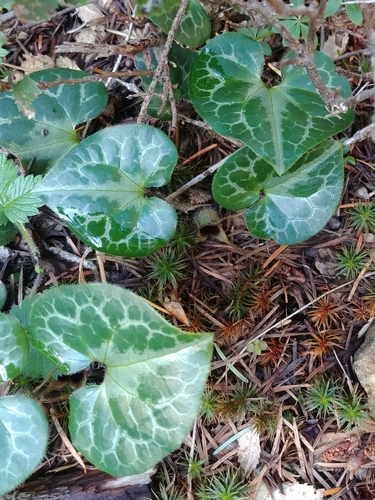
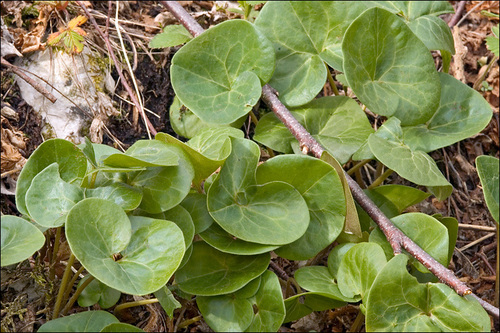
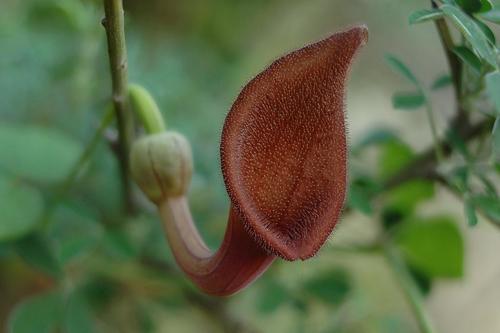
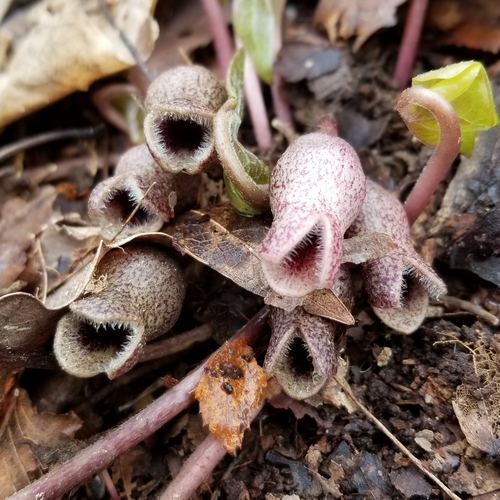
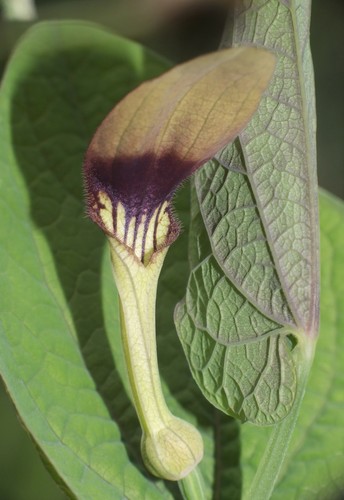
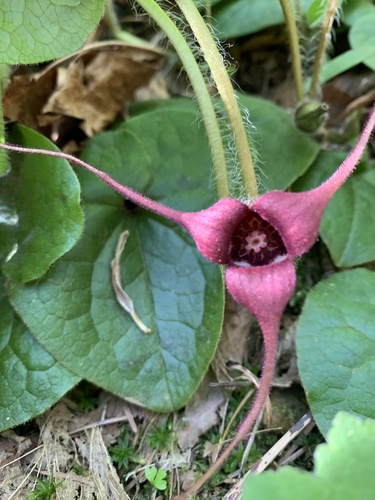
Asarum caudatum Lindl. grows from a long rhizome, and produces reniform (kidney- or heart-shaped) leaves that measure 2 to 10 centimetres (3⁄4 to 4 inches) in length. As the rhizome spreads, the plant grows in colonies or clusters, forming dense mats. When rubbed, the leaves release a ginger-like aroma. Blooming occurs from April to July, with blooming starting about one month earlier in British Columbia. The flower grows at the end of a 15 cm (6 in) leafstalk, and is often positioned on the ground, hidden beneath the plant's leaves. The flowers are hairy (hirsute), cup-shaped, and range in color from brown-purple to green-yellow. They end in three long, gracefully curved lobes. Asarum caudatum is distributed in British Columbia, Washington, Oregon, Northern California, Idaho, and Montana, where it grows in moist, shaded environments. Its northernmost populations are found near Meziadin Lake. It is a common herb in the understory of mixed conifer forests at elevations below 670 metres (2,200 ft), and is often a dominant plant in this habitat. A. caudatum reproduces via rhizomatous growth: many mats are formed by a single clonal plant connected by a shared rhizome. It can also reproduce sexually, and its seeds are dispersed by ants. The flowers are pollinated by flies, though cross-pollination is rare. Ants are attracted to a fatty appendage attached to each seed, and carry the entire seed back to their colonies. Once the ants recognize that only the appendage is edible, they typically drop the seed outside the nest. Because producing seeds with this ant-attracting appendage requires more energy, rhizomatous reproduction is more energetically favorable for the species. Members of the Aristolochiaceae plant family, which this species belongs to, contain aristolochic acid, a substance that has been identified as a carcinogen. The root of A. caudatum is edible. Native Americans used the plant for a range of medicinal purposes. Some people use A. caudatum as a substitute for ginger, and drink it as a tea that is attributed with medicinal properties. In a lab study testing the species' effects on fungus, A. caudatum showed antifungal activity when tested against nine fungal species.