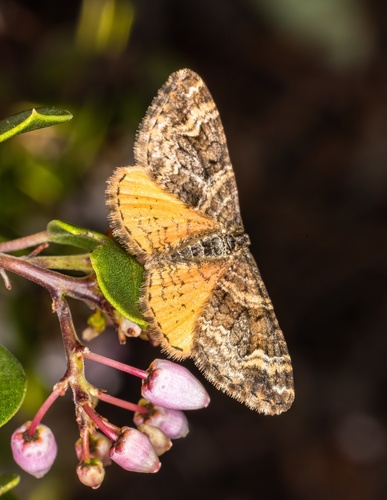
About Asaphodes clarata (Walker, 1862)
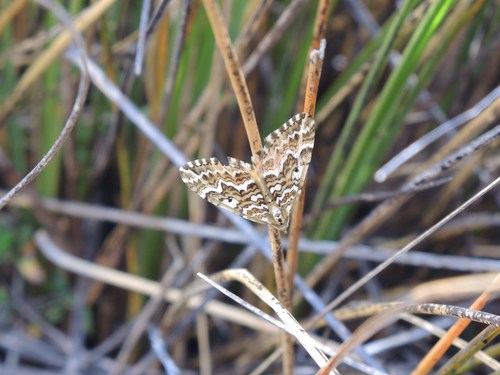
Description: Hudson described this species as follows: The male has a wing expansion of 1+1⁄2 inches, while the female has a wing expansion of 1+3⁄8 inches. The species differs from the previous related species in several distinct respects: the forewings have a brighter ground colour, the markings are less oblique and much more jagged. The large white central band is often broken into several distinct oval patches, the costal edge is only very slightly shaded with brown, and the transverse lines do not disappear before they reach the costa. The hindwings are bright ochreous. The cilia on all wings are white, strongly barred with yellowish-brown. This species varies in the intensity of its forewing colour and the width of its forewing white markings. Distribution: A. clarata is endemic to New Zealand. It is an upland species that occurs on tussock-covered slopes of mountain ranges in both the North and South Islands. It has been recorded in Otago and Canterbury. Habitat and host species: This species is found in open grassy patches in montane habitat. The larvae of this species feed on the foliage of Ranunculus species. Adult moths of this species have been recorded pollinating Celmisia laricifolia and Hebe pinguifolia, and are attracted to light.