About Asaphodes abrogata (Walker, 1862)
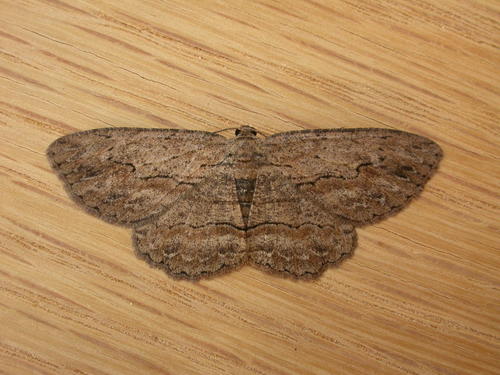
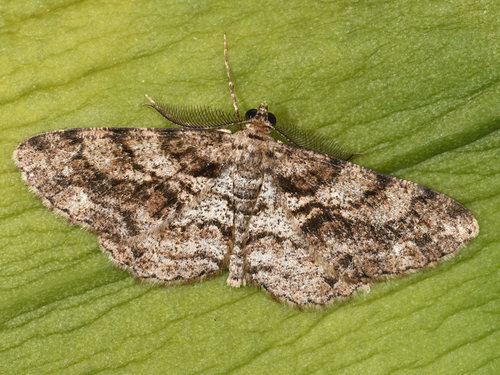
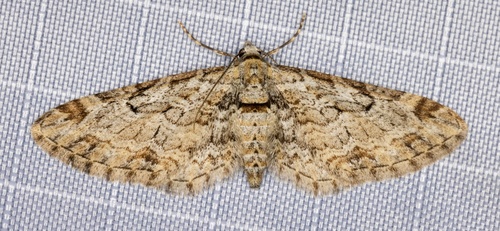
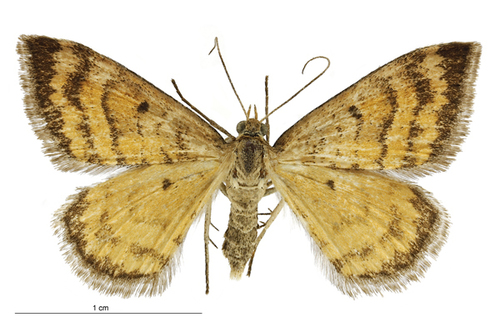
Asaphodes abrogata was first described by Walker, and later by Hudson. Walker’s original description of male specimens notes they are pale luteous. Palpi are porrect, fringed, rather slender, and extend beyond the head. Antennae are rather broadly pectinated, with branches that are remote from each other. Wings have a brown marginal band, which is incomplete on the fore wing. Fore wings are slightly acute; exterior and submarginal lines are brownish, undulating, and almost parallel, with the submarginal line apparent in patches on the hind wings. The costa and exterior border are slightly convex, and the exterior border is rather oblique. The undersides of the wings have broader, more distinct lines. Body length is 5 lines, and wing length is 12 lines. Hudson’s description notes the wing expansion is about 1 inch. All wings are ochreous with pale brown markings. Fore-wings have a conspicuous central dot, a fine wavy transverse line just beyond the middle, a subterminal line, and brown shading on the termen that is broader near the wing apex. Hind-wings have a brown central dot and two transverse lines. The cilia of all wings are brownish. The brown markings on the forewings of this species are variable, and a transverse line near the base of the forewings is sometimes present. This species is endemic to New Zealand. It is found in the South Island, particularly in Canterbury, Otago and Southland. A. abrogata inhabits open country and tussock grasslands, from sea level up to over 5000 ft above sea level. Hudson recorded that this species can frequently be observed at altitudes between 2000 and 4000 ft. Larvae have been reared on Plantago species, including Plantago coronopus. It has been recommended that the endemic New Zealand species Plantago raoulii be planted to attract this moth species.