About Arunta perulata (Guérin-Méneville, 1831)
Arunta perulata is a large cicada species native to Australia. It is commonly called the white drummer cicada. The name 'floury baker' was previously used for this species, but this name is now the specific common name for Aleeta curvicosta. Arunta perulata was first described in 1831 by Félix Édouard Guérin-Méneville, under the original scientific name Cicada perulata.
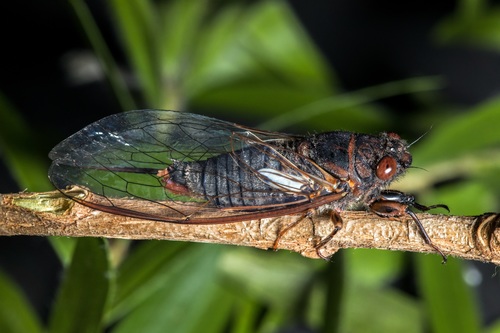
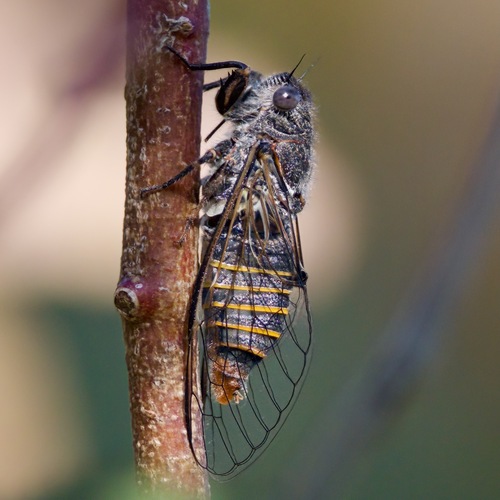
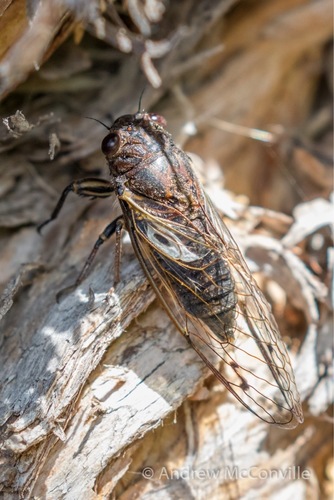
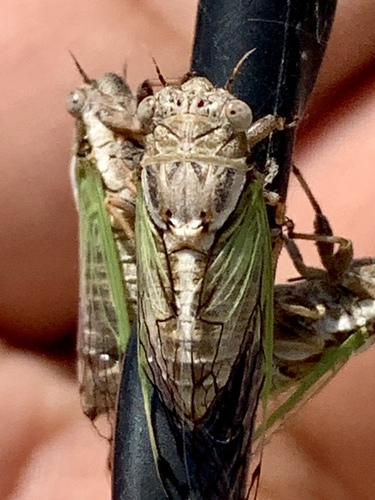
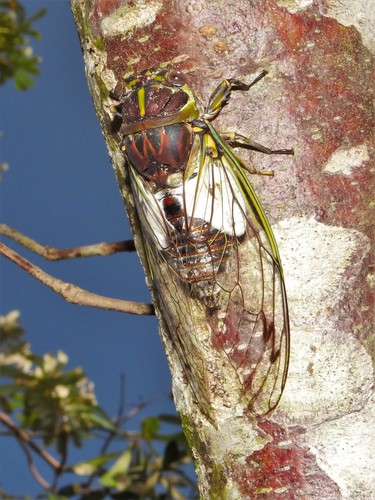
On average, adult male white drummer cicadas have a body length of approximately 3.75 cm, while adult females have an average body length of approximately 3.72 cm. The head is green, with prominent dark red-brown markings. A green midline runs along the pronotum, and the eyes are dark red-brown. The thorax and abdomen are predominantly dark red-brown. Depressions across the body are covered in yellow velvety fur, and the species' prominent sac-like tymbal covers are white. The wings are clear, with reddish brown and yellowish veins; male wings reach up to 4.97 cm long, while female wings reach up to 4.84 cm long. The legs are yellow-green, marked with dark brown and black.
Male white drummer cicadas produce a constant rattle-like call that can travel long distances, and they sing during the day and at dusk. Their call is made up of a series of pulses emitted at a rate of 65 pulses per second. Each pulse lasts 2.5 to 3.5 microseconds, and is followed by a 14-microsecond interval. The call has a frequency of 5.5 to 6.5 kHz, with a weak harmonic at 12 kHz. Like the related double drummer (Thopha saccata), this species' sac-like tymbal covers amplify its call.
Arunta perulata is found along Australia's eastern coastline, ranging from Cooktown in northern Queensland to Narooma in southern New South Wales. It has also been collected from far northern Cape York. Its preferred habitat is swampy forest and mangroves. The cicadas perch on trees including sheoak (Casuarina equisetifolia), swamp oak (Casuarina glauca), coast banksia (Banksia integrifolia) and coast wattle (Acacia sophorae). Adult white drummer cicadas emerge in December and January. Female cicadas of this species lay eggs exclusively on live branches.