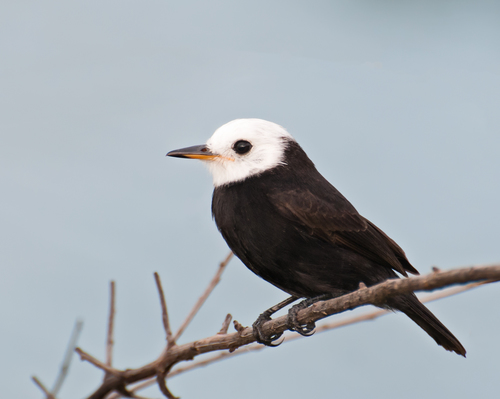
About Arundinicola leucocephala (Linnaeus, 1764)
The white-headed marsh tyrant, whose scientific name is Arundinicola leucocephala and is commonly called the marsh tyrant, is a small passerine bird in the tyrant flycatcher family. It is the only species in the genus Arundinicola. This diurnal bird is found only in South America, shows sexual dimorphism, and has monogamous mating behavior. This species is native to multiple South American countries: Argentina, Bolivia, Brazil, Colombia, Ecuador, French Guiana, Paraguay, Peru, Suriname, Trinidad and Tobago, and Venezuela. As its common name suggests, these birds live in tropical wetlands, including marshes, bogs, swamps, fens, peatlands, rivers, streams, creeks, and moist savannas. Many of the listed South American countries, including Brazil, Colombia, Peru, Ecuador, and Paraguay, have large areas dedicated to rice production. Arundinicola leucocephala has been recorded as one of the many non-aquatic species that occur in these ricelands. The white-headed marsh tyrant is generally a resident bird, but it may move when rapid turnover and ecological succession change habitats, if new suitable conditions become available. Recorded observations of relocated marsh tyrants exist from northeastern Peru and northeastern Ecuador along the Napo River. Nests are usually built within four feet of the ground in swamp bushes. The nests are spherical with a roof, and have a side opening near the top called the "porch". This opening is narrow, which helps protect the nest from predators. Nests are primarily built from dried grass, and their inner chambers are thickly lined with soft materials such as down. Completed nests measure roughly 4 inches high and 3 inches wide. The birds do not try to hide their nests, so the nests are quite easy to spot. Both parent birds take part in building the nest. In Satarem, Brazil, many nests were found within inches of the hives of a large wasp species. As a result, local people call the marsh tyrant "Mother of the Wasp". Ordered from most to least common, the most frequent breeding months are September, June, October and August, followed by November and July. The eggs this species lays are creamy white, and a single brood contains between 1 and 3 eggs. Each egg weighs between 1.8 and 1.9 grams, measures approximately 19.20 to 20.68 millimeters in length, and 11.10 to 14.58 millimeters in width. The incubation period lasts around 12 to 16 days, and both parents share the task of incubating. After hatching, young birds stay in the nest for 15 to 17 days before they are ready to leave. The average generation length for marsh tyrants is approximately 3.6 years. Marsh tyrants are most often found in pairs or small family groups, though they do sometimes forage alone. Evidence confirms the species is monogamous, as most individuals spend most of their time paired with a mate. If one partner disappears, it is replaced by a new mate. To attract a mate of the opposite sex, marsh tyrants perform pre-nuptial flights. During courtship, the bird's crest is prominent, and can be bushy or flattened depending on the stage of the display. The display usually includes an erect crest, loud vocalizations, and various wing positions: raised, fanned, or fluttering. This same behavior is also used when confronting rivals during aggressive conflicts. Marsh tyrants rarely spread or cock their tail.