About Aruncus dioicus (Walter) Fernald
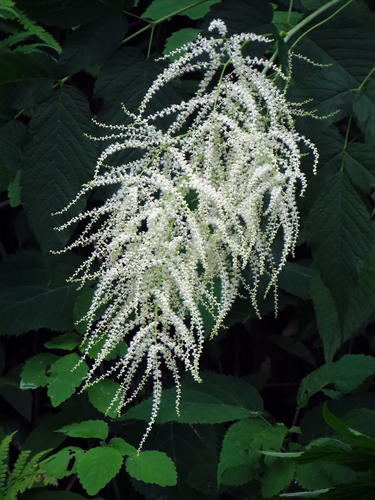
Aruncus dioicus (Walter) Fernald grows between 1.2 and 1.8 metres (4 to 6 ft) tall, and produces compound leaves made up of 3 or 5 leaflets. Its flowers are very small, have 5 petals, and are white or cream-colored; they are arranged in showy panicles that bloom from late spring to early summer. Male and female flowers grow on separate individual plants. The flower spikes rise well above the main foliage of the plant, which enhances the species' ornamental appeal, and male-flowering plants have showier blooms than female-flowering plants. This species grows naturally in moist woodlands, often at higher altitudes, across temperate regions of Europe, Asia, and eastern and western North America. In the United Kingdom, it is considered appropriate for planting in and around water features, and it has received the Royal Horticultural Society's Award of Garden Merit. Goat's beard, the common name for this plant, prefers humus-rich soil and full or partial shade; it can also be grown in full sun if it receives consistent moisture. Aruncus dioicus acts as a host plant for the dusky azure butterfly. In Italy, the young shoots of Aruncus dioicus are eaten: they are typically boiled briefly in herb-infused water, then cooked with eggs and cheese. In Friuli, it is one of the ingredients in pistic, the local homemade wild green-based soup. Aruncus dioicus var. kamtschaticus has demonstrated potent cytotoxic activity against Jurkat T cells. Native Americans in the Northwest used this plant medicinally as a diuretic and a poultice, and to treat blood diseases, smallpox, and sore throats.