About Arum cylindraceum Gasp.
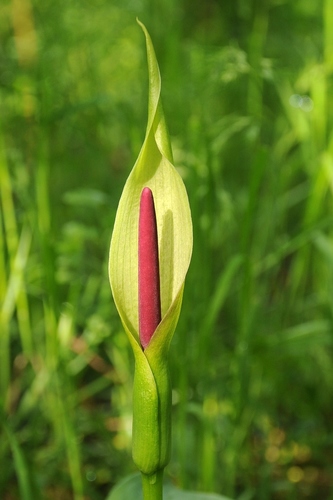
Arum cylindraceum Gasp. produces plain green leaves in early spring, between late March and early May. After leaves emerge, it develops flowers on a poker-shaped inflorescence called a spadix, which is partially enclosed by a grass-green, leaf-like spathe. The flowers are clustered out of sight at the base of the spadix: a ring of female flowers sits at the bottom, with a ring of male flowers above them. Above the male flowers is a ring of hairs that forms an insect trap. Insects are drawn to the spadix by its faecal odour and temperature, which is warmer than the surrounding ambient temperature. Trapped beneath the hair ring, insects get dusted with pollen from the male flowers before escaping, and carry this pollen to the spadices of other plants to pollinate their female flowers. The spadix of this species ranges in colour from pale chocolate brown to dark purple. In autumn, the lower ring of female flowers develops into a cluster of bright red berries, which remain visible after the spathe and other leaves have withered. These attractive red to orange berries are extremely poisonous. They contain saponin oxalates that form needle-shaped crystals, which irritate the skin, mouth, tongue, and throat. Consumption causes throat swelling, difficulty breathing, burning pain, and upset stomach. Because the berries have an acrid taste and cause an almost immediate tingling sensation in the mouth when eaten, large amounts are rarely consumed, and serious harm is unusual. All parts of the plant can trigger allergic reactions in many people, so the plant should be handled with care. Many small rodents find the spadix particularly attractive, and it is common to find specimens of this plant with large portions of the spadix eaten away. As its flowers mature, the spadix produces heat and likely scent, which may attract these rodents, though the spadix is scentless to humans. Where both Arum cylindraceum and Arum maculatum grow, the two species are easily confused. Arum cylindraceum does not usually grow wild in the UK, but both species occur in Central Europe, often growing in the same locations. The only consistently reliable trait to distinguish the two species year-round is the tuber: Arum maculatum has a horizontal tuber, while Arum cylindraceum has a vertical tuber. Other noted differences are as follows. The spadix of Arum cylindraceum is around two-thirds as long as its spathe, while the spadix of Arum maculatum is only half as long as its spathe. The spadix of Arum cylindraceum is never yellow, a colour that can occur in Arum maculatum. Arum cylindraceum never produces spotted leaves, except when it hybridizes with Arum maculatum; note that Arum maculatum, despite its name, does not always have spotted leaves, for example in the subspecies Arum maculatum ssp. immaculatum. The berry cluster of Arum cylindraceum can grow up to 7 cm long, while the berry cluster of Arum maculatum reaches a maximum length of 4 cm. The spathe of Arum cylindraceum is also greener than the paler spathe of Arum maculatum. Across its range, Arum cylindraceum grows in deciduous woodland or on the edges of coniferous woodland, and prefers partial shade and somewhat moist conditions. It can be found at elevations up to 1700 m, occurring at lower elevations in the northern part of its range. In the southern part of its range, it also grows on grassy or rocky slopes and in pastures. In medieval Denmark, which at the time included parts of Germany and Sweden, starch from the tubers of this species (and also Arum maculatum) was used to stiffen clerical collars. Because the tubers contain caustic sap that caused hand blistering, this use was abandoned once wheat starch became available. Today, colonies of Arum cylindraceum are still found growing close to church sites, though the species appears to have died out in southern Sweden.