About Artibeus jamaicensis Leach, 1821
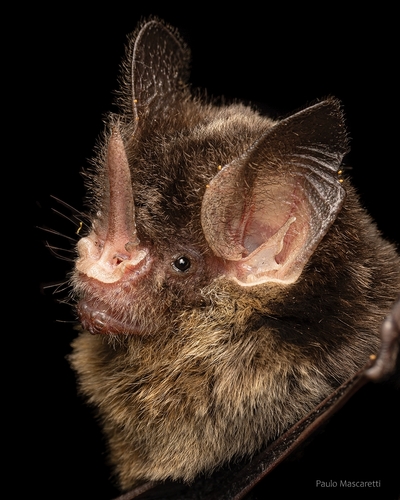
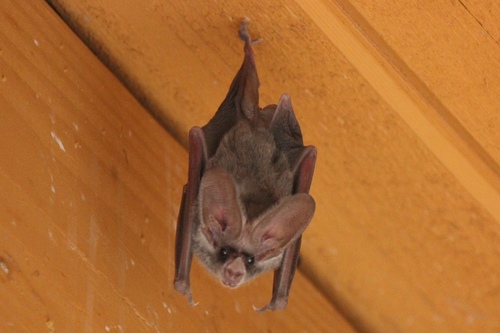
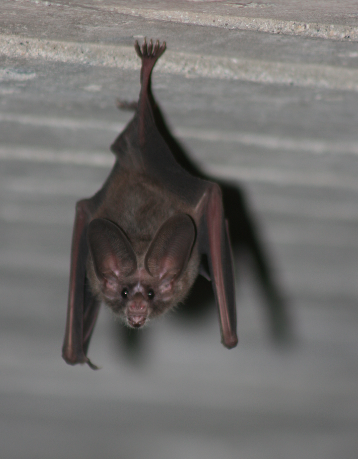
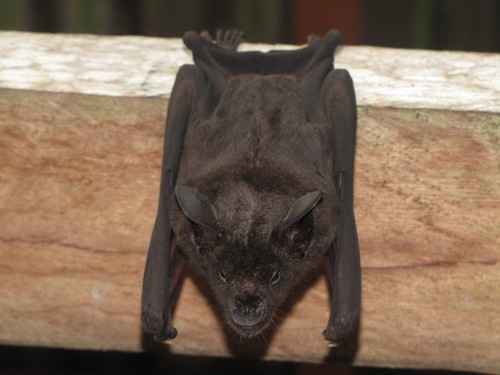
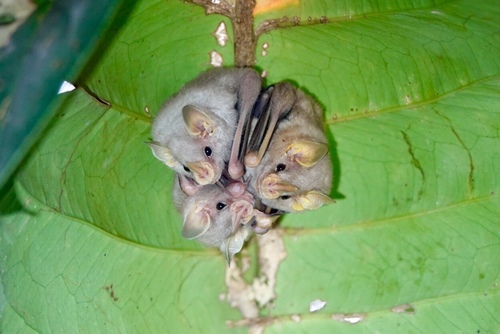
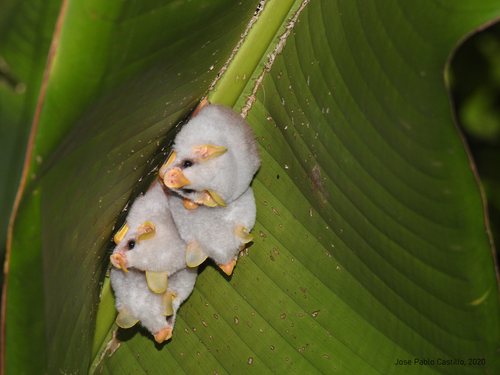
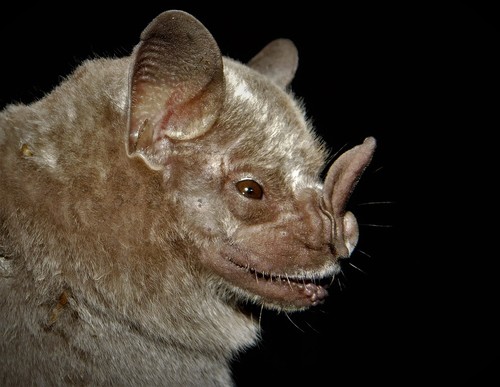
The Jamaican fruit bat (Artibeus jamaicensis Leach, 1821) is a medium-sized bat. Individuals have a total length of 78–89 mm (3.1–3.5 in), a wingspan of 96–150 mm (3.8–5.9 in), and a body weight of 40 to 60 g (1.4 to 2.1 oz). It has broad, pointed, ridged ears with a serrated tragus. Its prominent noseleaf holds an array of sebaceous glands. The lower lip is covered in warts, with one relatively large wart at its center, and sebaceous holocrine glands are present on both lips. The fur on its back is an ashy gray or ashy brown shade, with visible white hair bases, and it has variable fur patterning on its face. Its wings are broad and dark gray, and its underfur is paler than the back fur. This species has no external tail. It also has broad dark gray wings, a narrow hairless interfemoral membrane, and a short calcar. Distinctive features of the Jamaican fruit bat, which are also shared with some of its close relatives, include the absence of an external tail and a minimal, U-shaped interfemoral membrane. A transcriptome dataset is available for this species, containing more than 25,000 annotated transcripts that can be directly searched via BLAST, and a genome assembly for the species has also been generated. The Jamaican fruit bat's distribution ranges from southern Mexico through Central America, extending south to northwestern South America in Colombia. It also lives across all Caribbean islands of the Greater and Lesser Antilles, as well as the southern Bahamas. It can be found at elevations from sea level up to 2,135 m (7,005 ft). This species occurs in a wide variety of habitats. It prefers humid tropical habitats, but has also adapted to cloud forests and drier tropical habitats. Jamaican fruit bats roost in caves, hollow trees, dense foliage, buildings, and leaf tents. They may create their own roosting tents by modifying broad leaves, and these tents are only used on a temporary basis.