About Artemisiospiza belli (Cassin, 1850)
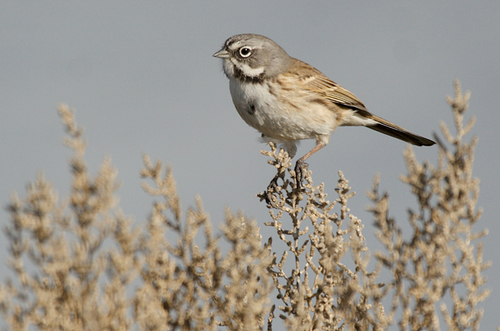
Bell's sparrow (scientific name: Artemisiospiza belli (Cassin, 1850)) is difficult to distinguish from the sagebrush sparrow in the field. Both species measure about 6 inches (15 cm) long and weigh approximately 16.5 g (0.58 oz). In general, for Bell's sparrow, the malar stripe is darker than the rest of the head, while for the sagebrush sparrow, the malar stripe is around the same shade of darkish gray as the head. Bell's sparrow also has a thicker malar stripe than the sagebrush sparrow. The amount of streaking on the back and the color shade of the mantle can also be used to separate the two species, but these traits are affected by feather wear. Bell's sparrow also has little or no white coloration in its tail, but this single field mark is not enough to be diagnostic on its own. Bell's sparrows are often closely associated with sagebrush habitats, though they can also be found in thick, brushy stands of saltbush, chamise, and other low shrubs in the arid western United States. The subspecies A. b. clementeae has been listed as threatened since 1977. This subspecies has increased in population size since then, due to conservation efforts carried out by the US Navy that led to the regrowth of native vegetation. It has been proposed for removal from the Endangered Species Act by the US Fish & Wildlife Service. Both the species' common name and its specific epithet belli refer to John Graham Bell.