About Artemisia maritima L.
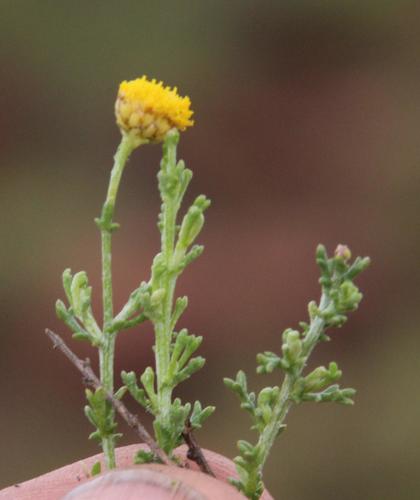
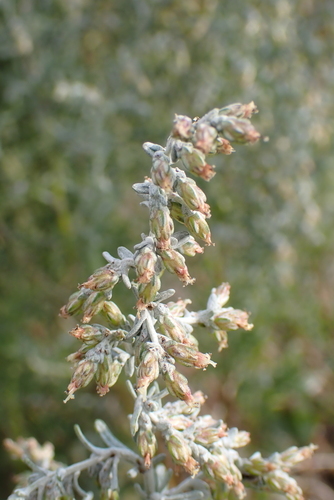
Artemisia maritima L., commonly known as sea wormwood, is a herbaceous perennial plant or subshrub. It grows to 50 cm in height, flowers from August to September, and produces wind-pollinated blooms. Its foliage is strongly aromatic, and ranges in color from pale grey-green to whitish-green. The leaves are deeply twice pinnatifid, with narrow, linear segments. Both leaves and the entire plant are covered on all surfaces by a dense layer of white cottony hairs. Its small, oblong flower heads measure 1–2 mm in diameter, each holding three to six tubular florets. The flower heads are yellowish or brownish in color, produced in August and September, and arranged in racemes that can be either drooping or erect. Sea wormwood serves as a caterpillar food plant for the species Eupithecia extensaria. This species is somewhat similar in appearance to two related species: wormwood (Artemisia absinthium) and hoary mugwort (Artemisia stelleriana). It can be distinguished from these by its slenderer leaf segments, which are less than 2 mm wide. In addition, A. stelleriana does not have the strong aromatic scent that sea wormwood has. All reported records of this species from southeastern Europe come from misidentification; the name was incorrectly applied to the closely related species Artemisia santonicum. Sea wormwood grows mostly on saline soils. It can be found on the drier sections of saltmarshes, brackish ditches, sea cliffs, and coastal shingle. Like many other saltmarsh plants, it has begun to colonize inland areas along roadsides that are salted to melt winter ice and snow.