About Artemisia frigida Willd.
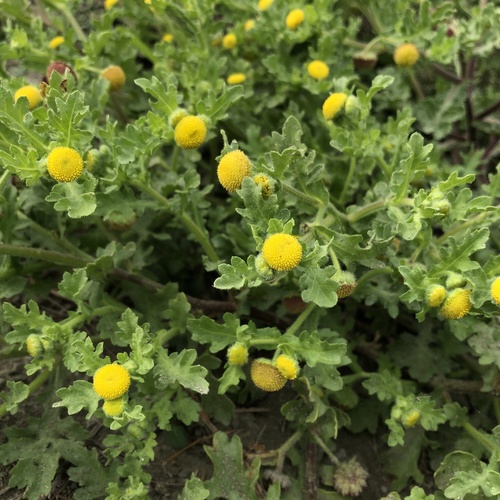
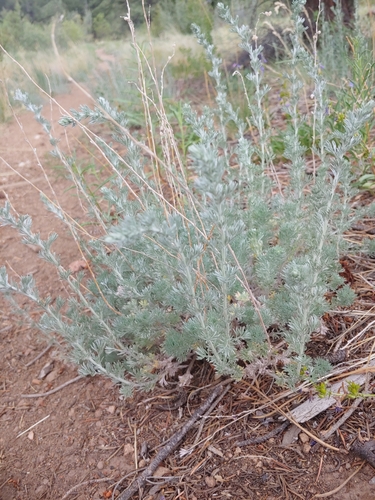
Artemisia frigida Willd. is a perennial plant with a woody base. Its spreading stems usually form a mat or clump that grows up to 40 centimeters (1.3 ft) tall. Stems are covered in lobed gray-green leaves coated in silvery hairs. The inflorescence holds many spherical flower heads, each around half a centimeter wide, lined with woolly-haired gray-green or brownish phyllaries. Each flower head contains several pistillate ray florets and many bisexual disc florets. This is an aromatic plant with a strong scent. It can produce a very large number of seeds, and can also spread via layering; some years it produces very few seeds. Artemisia frigida is common, and often dominant or codominant across many areas, especially in dry and disturbed habitat types. It is common in the Rocky Mountains and Great Plains of North America, where it grows in grasslands, shrublands, woodlands, and other habitat types. It tends to become more abundant in areas heavily grazed by livestock, and its overgrowth is sometimes an indicator of overgrazing on rangeland. It may sometimes become an aggressive weed. Ranchers have viewed this species as both an adequate forage crop and a worthless nuisance. Its common name is wild sage, and it is also sometimes called prairie sage or sagewort. A number of wild animals feed on this plant, including white-tailed jackrabbits and sage grouse. It has a variety of uses for Indigenous peoples of North America. The Blackfoot use it medicinally to treat coughs, colds, wounds, and heartburn. Cree people use it for headache and fever, and Tewa people use it to treat gastritis and indigestion. It also has ceremonial and veterinary uses; for example, Blackfoot people reportedly used crushed leaves to revive gophers after children clubbed them during a game. Among the Zuni people, the whole plant is made into an infusion to treat colds. Sprigs of this plant and corn ears are attached to decorated tablets and carried by female dancers in a drama. Sprigs are also dipped in water and planted with corn to encourage abundant corn growth. Mongol herders from the Bairin Right Banner and Bairin Left Banner of Inner Mongolia prepare a water-based decoction of fresh or dried Artemisia frigida mixed with Sabina vulgaris, Sanguisorba officinalis, Rhododendron micranthum, and Ephedra sinica to treat joint pain. Artemisia frigida is cultivated for the ornamental effect of its foliage, and has earned the Royal Horticultural Society's Award of Garden Merit. Wildflower cultivation author Claude A. Barr stated that this species and Artemisia longifolia are the only two Artemisia species that can be safely planted in a garden, as other species such as Artemisia tridentata spread too aggressively. It is also used in landscaping, for erosion control, and for revegetation of rangeland, and it is drought-resistant.