About Artemisia filifolia Torr.
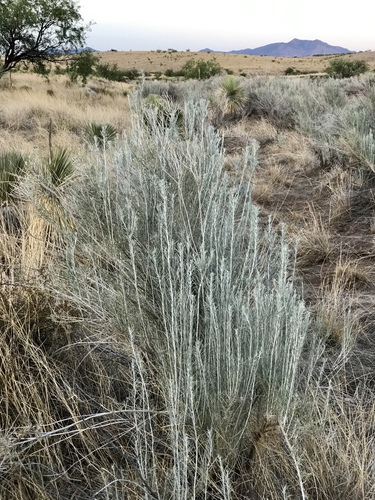
Artemisia filifolia Torr. is a branching woody shrub that reaches a maximum height of 1.5 metres (4 ft 11 in). Its stems are covered in narrow, threadlike leaves that grow up to 8 centimetres (3.1 in) long and are no more than half a millimeter wide. Leaves are sometimes split into segments, and they can be solitary or arranged in fascicles. Leaf color is grayish-green. The inflorescence is a panicle of hanging flower heads. Flower color is either yellow or brown, and each flower head contains sterile disc florets and 2 to 3 fertile ray florets. Bloom occurs between August and November. The fruit is a tiny achene, and achenes generally do not disperse far from the parent plant. Artemisia filifolia is a dominant species across much of the west-central United States, especially in areas with deep, sandy soil, and it acts as an indicator of sandy substrate. It is effective at preventing erosion on these sandy soils. It is common in parts of the Great Plains, where it is a dominant component of prairie, grassland, and shrubland ecosystems, growing alongside grasses including sand bluestem, grama grasses, sand reedgrass, little bluestem, and sand dropseed. Regions where this sagebrush forms dominant stands include sandsage prairie stretching from Nebraska to central Texas, various river systems in eastern Colorado and Kansas, the sandhills and mixed-grass prairies of Colorado, and parts of southeastern Wyoming. In Texas, it is common in the Trans-Pecos region where it grows with honey mesquite, and in many other areas of the state where it grows with sand shinnery oak. Ecosystems dominated by this species are most commonly affected by fire and grazing. Before modern fire suppression, these ecosystems were maintained by a disturbance pattern of natural wildfire and bison grazing called pyric herbivory. Sand sagebrush seed from this species is sold commercially, and it is sometimes used for revegetation projects on rangeland and coalfields. The Navajo people had multiple uses for the plant, including medicinal applications and ritual use. The soft plant material was also used as toilet paper.