About Artemisia dracunculus L.
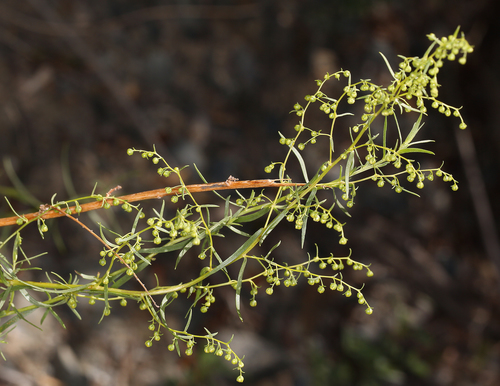
Tarragon (Artemisia dracunculus), also called estragon, is a perennial herb species in the Asteraceae family. It grows wild across most of Eurasia and North America, and is cultivated for both culinary and medicinal uses. One subspecies, Artemisia dracunculus var. sativa, is grown to use its leaves as an aromatic culinary herb. Many other subspecies lack the characteristic tarragon aroma. Common informal names for the cultivated variations are "French tarragon", which is considered best for culinary use, and "Russian tarragon". Tarragon reaches 120–150 centimeters (4–5 feet) in height, and grows slender branches. Its leaves are glossy green, lanceolate shaped, 2–8 cm (1–3 in) long and 2–10 mm (1⁄8–3⁄8 in) wide, with smooth unbroken margins. It produces small flower heads called capitula that are 2–4 mm (1⁄16–3⁄16 in) in diameter; each capitulum holds up to 40 yellow or greenish-yellow florets. French tarragon rarely produces any flowers or seeds. Some tarragon plants produce mostly sterile seeds, while others produce viable seeds. Tarragon has rhizomatous roots that it uses to spread and reproduce easily. French tarragon is the variety grown for kitchen cooking, and cannot be grown from seed because its flowers are sterile. Instead, it is propagated by dividing its roots. Russian tarragon (often classified as A. dracunculoides L.) can be grown from seed, but has a much milder flavor than the French variety. Russian tarragon is a much hardier, more vigorous plant, spreads via its roots, and grows over one meter tall. It prefers poor soils, and tolerates drought and neglect well. While it is not as strongly aromatic and flavorful as French tarragon, it produces far more leaves starting from early spring. These leaves have a mild flavor that works well in salads and cooked dishes. Russian tarragon loses what little flavor it has as it ages, and is widely considered useless as a culinary herb, though it is sometimes used in crafts. Its young early-spring stems can be cooked and eaten as a substitute for asparagus. Horticulturists recommend growing Russian tarragon from seed indoors, then planting it out in summer. Its spreading clumps can be divided easily. A better substitute for Russian tarragon is Mexican tarragon (Tagetes lucida), which is also known as Mexican mint marigold, Texas tarragon, or winter tarragon. Its flavor is much more similar to French tarragon, with a subtle hint of anise. Although it does not belong to the same genus as French and Russian tarragon, Mexican tarragon has a more robust flavor than Russian tarragon that does not decrease significantly with age. It cannot be grown as a perennial in cold climates, however. In culinary use, fresh tarragon is eaten with white Syrian cheese in Syria, and is also added to dishes like shish barak and kibbeh labaniyeh. In Iran and Armenia, tarragon is served as a side dish for sabzi khordan/kanachi (a meal of fresh herbs), or added to stews and Persian or Armenian-style pickles called t‘tu, most commonly khiar shoor (pickled cucumbers) and other pickled vegetables or fruits. Tarragon is one of the four fines herbes of classic French cooking, and is especially well-suited for chicken, fish, and egg dishes. It is the main flavoring ingredient in Béarnaise sauce. Fresh, lightly crushed tarragon sprigs are steeped in vinegar to make tarragon vinegar. When pounded into butter, it creates an excellent topping for grilled salmon or beef. Tarragon is used to flavor a popular carbonated soft drink called Tarkhuna in Armenia, Russia, Georgia (where the drink originates), and neighboring Ukraine and Kazakhstan. Tarkhuna is made from sugar, carbonated water, and tarragon leaves, which give the drink its characteristic green color. Tarragon is also one of the ingredients in Chakapuli, a traditional Georgian dish.