About Artemisia absinthium L.
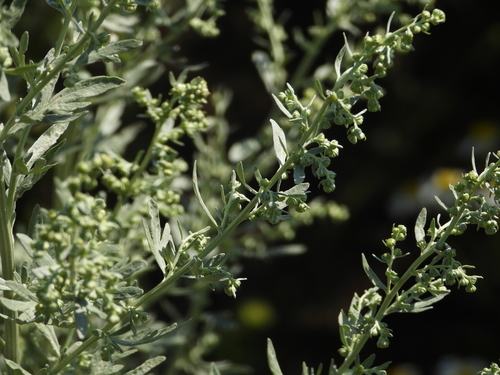
Artemisia absinthium L. (common name wormwood) is a herbaceous perennial plant with fibrous roots. Its straight stems grow 0.8–1.2 m (2 ft 7 in – 3 ft 11 in) tall, rarely exceeding 1.5 m (4 ft 11 in); stems are grooved, branched, silvery-green, and carry a strong odor. Leaves are arranged spirally, and are greenish-grey on the upper surface, white on the lower surface. They are covered in silky silvery-white trichomes and bear minute oil-producing glands. Basal leaves reach up to 250 mm (10 in) long, are bi- to tripinnate, and have long petioles. Cauline leaves (growing on the stem) are smaller, between 50–100 mm (2–4 in) long, less divided, and have short petioles. The uppermost leaves may be simple and sessile (lacking a petiole). Flowers are pale yellow, tubular, and clustered in spherical bent-down heads called capitula. These capitula are further clustered into leafy, branched panicles. Flowering occurs from early summer to early autumn, and pollination happens via wind (anemophilous). The fruit is a small achene, and seeds are dispersed by gravity. A. absinthium grows naturally on uncultivated arid ground, rocky slopes, and at the edges of footpaths and fields. Though it was once relatively common, it is becoming increasingly rare in Britain, where recent studies suggest it is an archaeophyte rather than a true native species. Most chemotypes of A. absinthium contain (−)-α- and/or (+)-β-thujone, though some chemotypes do not. On its own, (−)-α-thujone is a GABAA receptor antagonist that can cause convulsions when given in large doses to animals and humans. However, there is only one documented case of toxicity from wormwood: a 31-year-old man drank 10 mL of steam-distilled pure volatile wormwood oil, having mistaken it for absinthe liqueur. Medicinal wormwood extracts have not been shown to cause seizures or other adverse effects at usual doses. Thujones have not been proven to be the cause of toxicity from excessive doses of any wormwood extracts, including absinthe. This plant can be easily cultivated in dry soil. It should be planted in bright exposure in fertile, midweight soil, and prefers soil rich in nitrogen. It can be propagated by ripened cuttings taken in spring or autumn in temperate climates, or by seeds planted in nursery beds. Growing A. absinthium alongside other plants tends to stunt the growth of the neighboring plants, so it is not considered a good companion plant. A. absinthium also self-seeds generously. It has become naturalized in many areas outside its native range, including most of North America and the Kashmir Valley of India. The species itself, along with its cultivars "Lambrook Mist" and "Lambrook Silver", has received the Royal Horticultural Society's Award of Garden Merit. These two short cultivars are very similar, more silver in color than typical A. absinthium grown in Britain, and probably originate from southern Europe. "Lambrook Silver" is the older of the two cultivars, selected in the late 1950s by Margery Fish, who developed the garden at East Lambrook Manor. "Lambrook Mist" was selected roughly 30 years later by Andrew Norton, a later owner of the garden. Both cultivars received their Awards of Garden Merit during the RHS Artemisia Trial held from 1991 to 1993. Cultivar "Silver Ghost" is a taller, silver-leaved plant that flowers much later (August to September) than typical A. absinthium in Britain, which flowers from June to July. This means it retains its silver appearance for a longer period. In the 1990s, National Collection Holder John Twibell selected "Silver Ghost" and "Persian Lace", a more feathery-leaved cultivar. Artemisia absinthium is claimed to have antifungal, neuroprotective, insecticidal, antimicrobial, anthelmintic, acaricidal, antimalarial, antidepressant, and hepatoprotective properties. It is an ingredient in the spirit absinthe, and is used for flavoring in a number of other spirits and wines, including bitters, bäsk, vermouth, and pelinkovac. In folk medicine, it is claimed to stimulate poor appetite and treat various conditions including Crohn's disease and IgA nephropathy. Wormwood was traditionally a common bittering spice for farmhouse brewing in Denmark, and to a lesser extent in Estonia. In 18th-century England, wormwood was sometimes used in place of hops in beer. According to Nicholas Culpeper, drinking a glass of wormwood beer every morning can cure a stinking breath. Historical sources record the use of Artemisia absinthium as an anthelmintic and antiprotozoal remedy, while modern studies report antibacterial, antifungal, and antibiofilm activity for its extracts. In the 19th century, wormwood-based alcoholic preparations including absinthe were prescribed as prophylaxis during the French conquest of Algeria. Wormwood clippings and cuttings are added to chicken nesting boxes to repel lice, mites, and fleas. Studies by Bailen et al. 2013 and Gonzalez-Coloma et al. 2013 found that the unique terpenoids of the Gonzalez-Coloma chemotype make this strain particularly promising for insect control. As of 2020, a company called EcoflorAgro is investing heavily to expand the planted area of this strain, with the goal of commercializing it; commercialization of other botanical insecticides has been attempted but never achieved before due to unreliable supply.