About Artamus personatus (Gould, 1841)
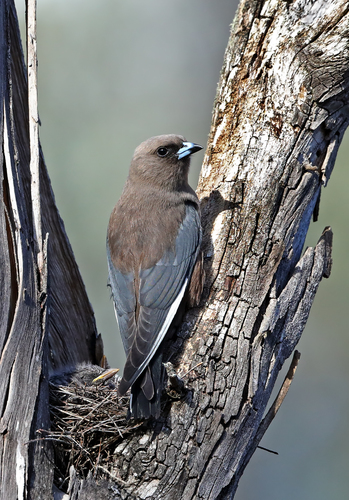
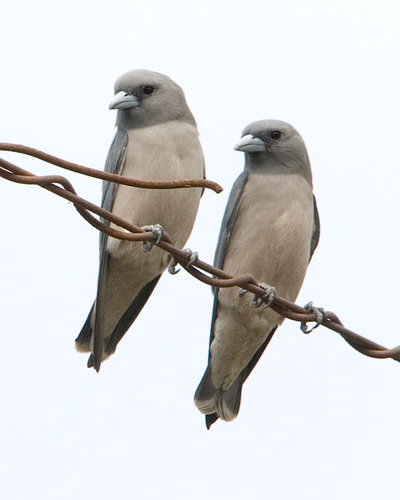
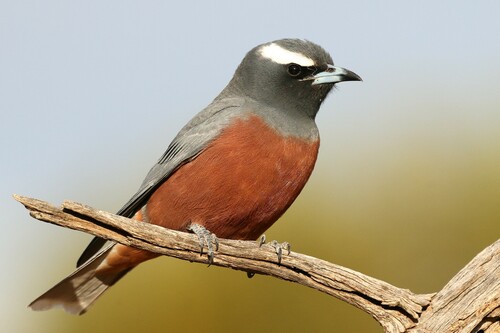
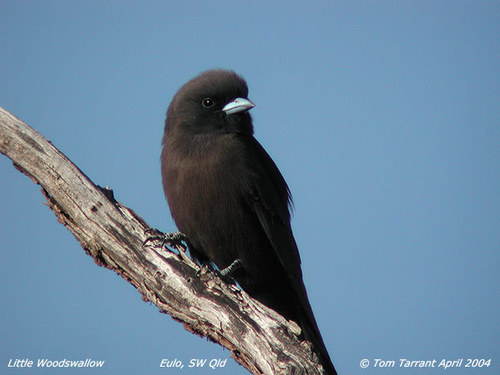
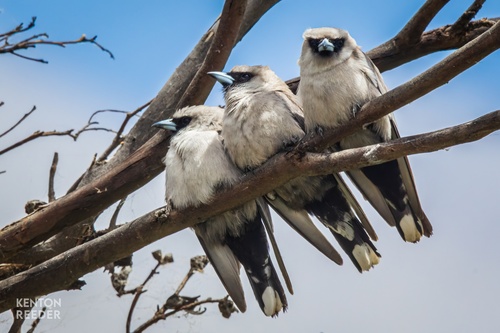
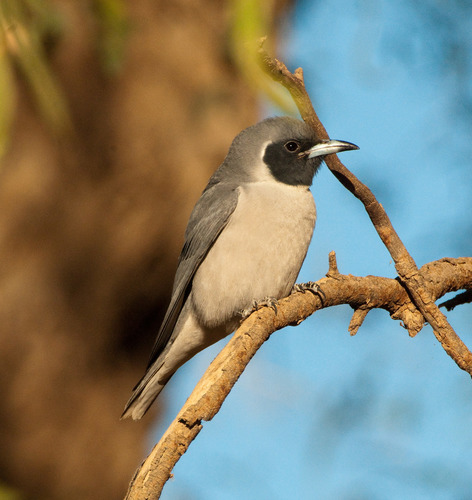
Artamus personatus, commonly known as the masked woodswallow, is a common, gregarious, and highly nomadic bird species. It typically appears in large flocks, often alongside the white-browed woodswallow (Artamus superciliosus). It is among the few passerine bird species that have powder down distributed through their plumage, and it is currently listed as Least Concern on the IUCN Red List. Adults measure 18–20 cm in length, with a 32–34 cm wingspan, and weigh approximately 37 grams; this matches the size of the white-browed woodswallow. Marked differences in plumage color exist between adult males, adult females, and immature birds, and this distinct sexual dimorphism is only shared between the masked woodswallow and the white-browed woodswallow. Adult males have a sharply defined black face mask with a pale edge, which covers the lores, ear coverts, chin, and throat. Their upperparts are dark blue-grey, with a prominent white tip on the tail. Their underbody is pale grey, fading to greyish white on the under tail coverts, and their legs and feet range from grey to grey-black or solid black. Adult females are similar to adult males, but are slightly browner overall and have an indistinct face mask. Juveniles are similar to adult females, but are slightly browner with flecked and mottled buff plumage. This species is widespread across mainland Australia, and is less common in coastal and near-coastal areas of the continent. Vagrant individuals have been recorded in Tasmania, New Zealand, Norfolk Island, and Lord Howe Island. It mainly inhabits open forest, woodland, heath, roadside tree belts, and farm tree belts, and occurs most often in arid and semi-arid zones.