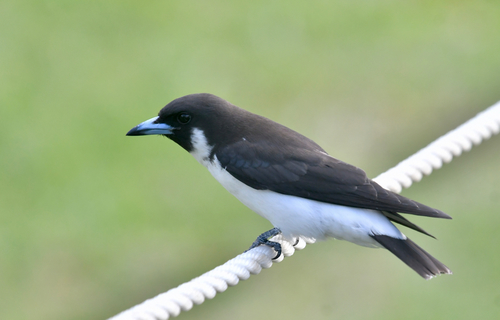
About Artamus minor Vieillot, 1817
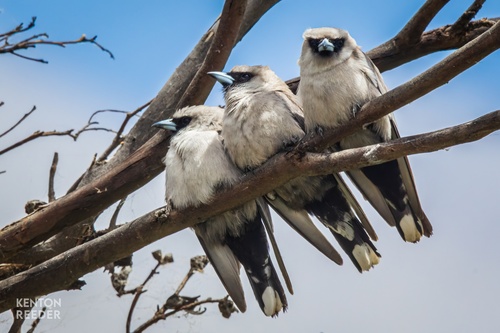
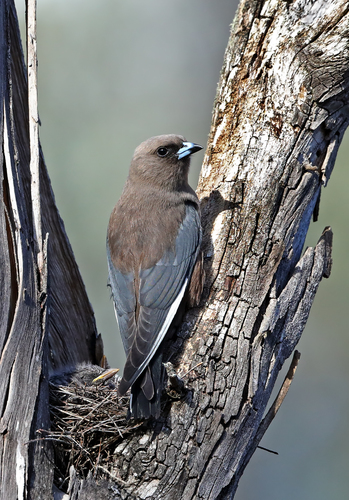
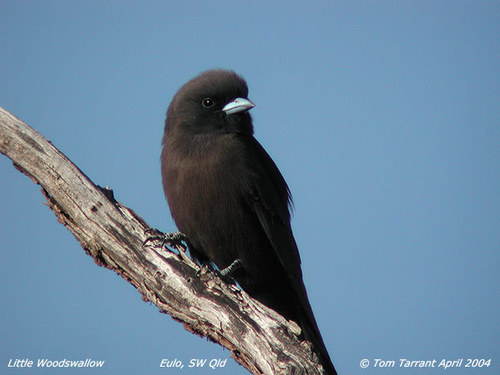
The little woodswallow, whose scientific name is Artamus minor, is a bird that lives across most of mainland Australia in patchy distributions. It avoids the driest deserts and the region within roughly 300 kilometres of Australia’s southern coastline, and it prefers rugged terrain around inland ranges. As the common name suggests, this species is the smallest woodswallow, measuring 12 to 14 centimetres in total length. Its plumage is dark, smoky brown across most of its body, with deep gunmetal grey wings, and a blue-tinged bill tipped with black. Like all other woodswallow species, little woodswallows gather in tightly huddled groups to rest or sleep on tall, dead branches. Typical group sizes are small to moderate, but it is not unusual for hundreds of individuals to gather together at a single roost site. When hunting flying insects, little woodswallows soar easily above treetops or along cliff faces; their small size means they are often mistaken for martins. Their nests are simple, rough structures built from twigs and other plant material, placed in tree hollows or similar enclosed spaces. Breeding occurs between August and January, or after rainfall events. Females lay three eggs per clutch. Young little woodswallows leave the nest when they are barely able to fly, after which they perch on nearby trees and call constantly to beg for food from their parents.