About Artamus fuscus Vieillot, 1817
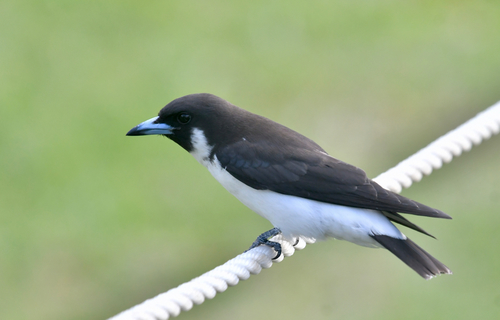
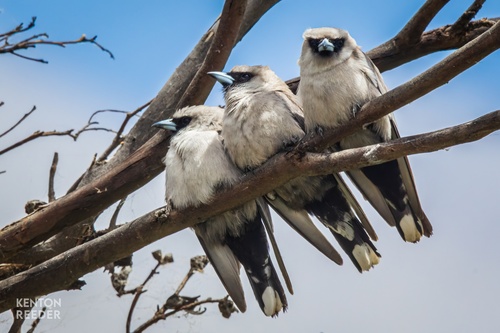
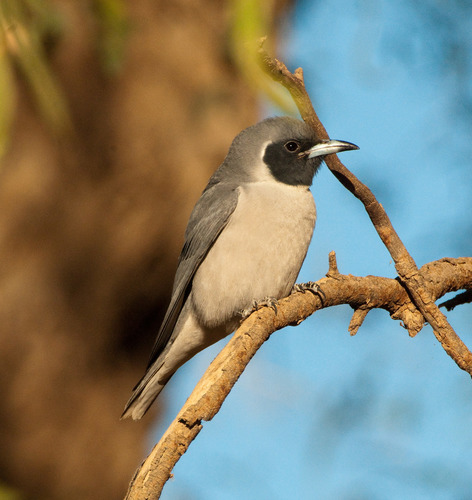
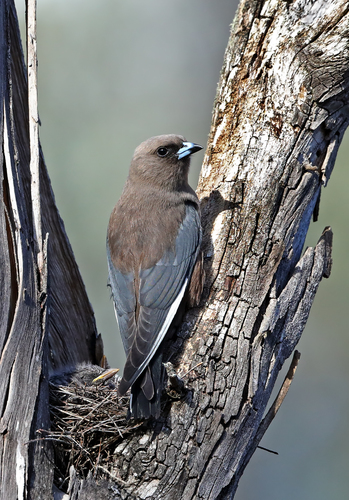
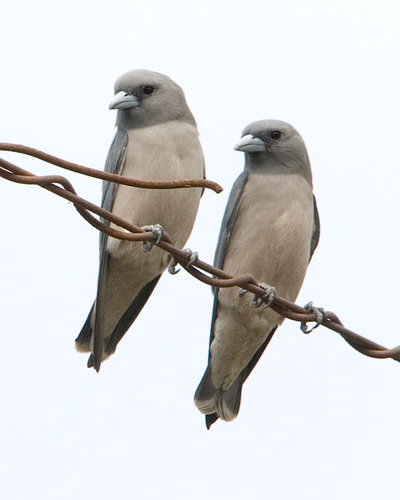
This stocky woodswallow, Artamus fuscus, has ashy grey upperparts, a darker head, and a narrow pale band on the rump. Its underside is pinkish grey, and its short slaty black tail has white tips. Its finch-like bill is silvery. In flight, the long wing is very broad at the base, creating a distinctly triangular outline, and the first primary is very short. Adults have short legs, and typically perch on high vantage points to launch aerial foraging sallies. This species has no documented geographic plumage variation, and no subspecies have been formally named. Males and females cannot be distinguished from each other in the field, though one old report notes potential sex differences in the color of the mouth's inner surface. Juveniles have barred patterning on the underside. This woodswallow inhabits a range of environments from lowland plains up to approximately 2000 meters in elevation, including cultivated areas, forest clearings, and landscapes with tall palm trees. It is widely distributed across Bangladesh, India, Nepal, Sri Lanka, Thailand, Myanmar, Laos, Malaysia, and China. It is not found in the very arid regions of western India, and has been recorded on the Maldives. Ashy woodswallows are most often observed in small groups. Multiple individuals may huddle side-by-side on the bare branches of tall trees, and will sometimes preen each other. They also use other high perches including powerlines and pylons. From their perches, they launch aerial sallies, alternating flapping and gliding to catch insects mid-flight. Captured insects may be held in the beak, transferred to and held by the feet, torn apart with the bill, and swallowed without returning to the perch; they may also return to a perch to consume caught prey. They sometimes sit on the ground, and have been recorded visiting bird baths. While they feed primarily on insects, they will also take nectar from the flowers of trees such as Erythrina. They have been observed feeding on toxic butterflies from the family Danaiidae, specifically Euploea core, which other bird species avoid. In India, the breeding season runs from March to June. The nest is a shallow cup placed at height, for example at the base of a frond of a tall palm or in the hollow at the top of a street lighting post. A typical clutch holds 2 to 3 greenish white eggs marked with brown spots. Both parent birds participate in nest building, incubation, and feeding the hatchlings. They will mob larger birds including crows and birds of prey that come too close to their nest. Their song is a varied combination of wheezy notes, and may include imitations of other birds' calls. Their most common call is a shrill nasal chewk. They make seasonal movements, likely in response to rainfall patterns. Artamidae, the woodswallow family, is one of the few perching bird groups that have specialized feathers called powder down. These feathers break down into fine dust that the bird spreads over its body during preening; powder down is also found in egrets. Members of this family have a brush-tipped tongue, and some of their thoracic vertebrae are fused into a structure called the notarium. Several parasite species have been recorded from this host: an ectoparasitic birdlouse, Menacanthus elbeli, and a mite that lives inside feather quills have been described from this species. Documented endoparasites include the trematodes Plagiorchis dactylopharynx, Papillatrema echinata, and Stomylotrema travassosi.