About Artamus cinereus Vieillot, 1817
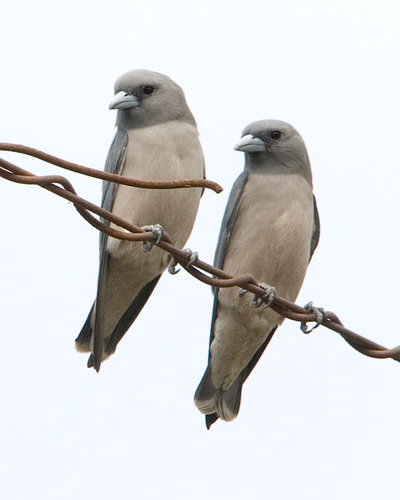
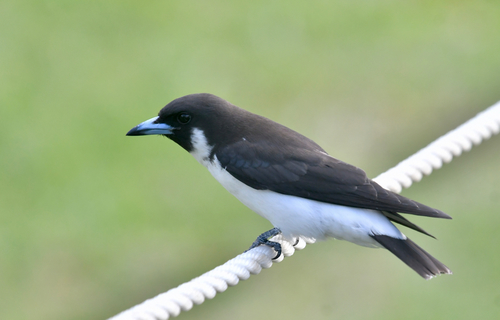
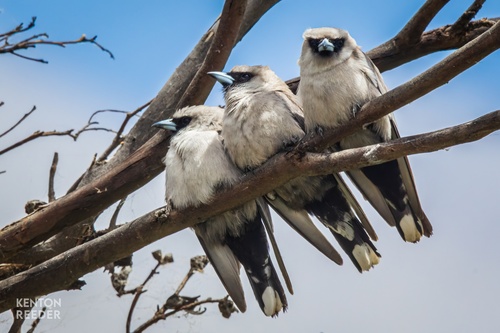
The black-faced woodswallow, Artamus cinereus Vieillot, 1817, measures 18–19 cm (7.1–7.5 in) in length and weighs 32–40 g (1.1–1.4 oz). It has a blue-grey beak with a black tip, and a black facial mask that extends from the base of the bill up to and around the eyes. Its plumage is ash grey, lighter on the breast and darker on the wings, with silver underwings. The tail is black with a white tip. Subspecies of this species are distinguished by the colour of their tail vents: either black or white. The white-vented subspecies A. c. normani and A. c. inkermani are found on Cape York Peninsula and in northern Queensland, respectively. The black-vented subspecies A. c. cinereus occurs in south west Australia, while A. c. melanops lives in northern Australia and the Lesser Sunda Islands, including Timor. Males and females have similar colouration. Juvenile black-faced woodswallows have brown bodies and wings with buff streaks, and a pale yellow beak. Their voice consists of soft, animated calls including chiff, chap, and chattering, and they can also perform vocal mimicry. This species has a broad distribution across Australia, occupying most of the continent except for the southeastern coastal margin. It is mainly sedentary, staying in arid and semi-arid areas even during dry conditions, though it can be partly nomadic. It prefers open eucalypt woodlands, scrub, and spinifex habitats in arid and semi-arid zones. In tropical savannahs, it favours open woodlands and grasslands. Black-faced woodswallows frequently flock with finches, and sometimes flocks with the golden-shouldered parrot. This species is mainly insectivorous. It is an aerial feeder that can soar, hover, and dive to catch insect prey including moths. It also often feeds on the ground to take ground insects, and may dismember insects it has caught on the wing. It has brush-like tongues for gleaning nectar, and will occasionally feed on flowers.