About Arses kaupi Gould, 1851
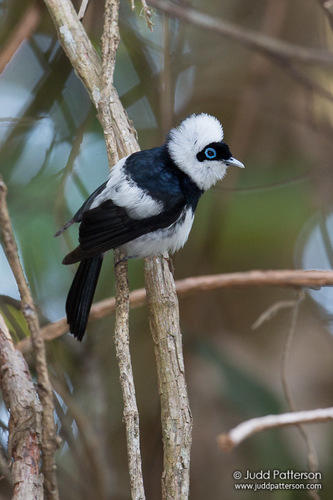
The pied monarch (Arses kaupi Gould, 1851) measures 15–16 centimetres (5.9–6.3 in) in length and weighs approximately 12.5–15 grams (0.44–0.53 oz). Its plumage is sexually dimorphic. Males have black upperparts, head, and tail; their wings are brownish-black with white scapulars that form a white crescent across the back when the wing is folded. Males have an erectable white collar that connects through the neck to a white throat, a black breast-band, and white belly and underparts. In females, the white throat and collar cover less area and are less distinct, with the collar being incomplete around the neck. Both sexes have black eyes surrounded by a blue eye-ring, which is less distinct in females. The bill is blue-grey, and the legs are black. Immature birds resemble females but have duller plumage, no blue coloration in their eye-rings, and a horn-coloured bill. Like other species in its genus, the pied monarch has long hind-toes and claws. The overall size and shape of its feet resemble those of Australasian treecreepers, and it uses its feet in the same way for feeding on tree trunks. The pied monarch occurs in coastal north eastern Queensland, Australia, ranging from Cooktown to Ingham. It inhabits tropical forest edges, secondary growth, palm-vine scrub, gallery forest, and areas along rivers, and can be found from sea level up to 900 metres (3,000 ft). The species is mostly non-migratory, though some individuals disperse to Eucalyptus woodland on the Atherton Tableland during winter. It has a very small global range and is described as uncommon, occurring at low densities across its range. Most of its range is protected within national parks or World Heritage Sites, and its habitat is considered secure. Currently, the species is assessed as Least Concern by the IUCN.