About Arsenura armida Cramer, 1780
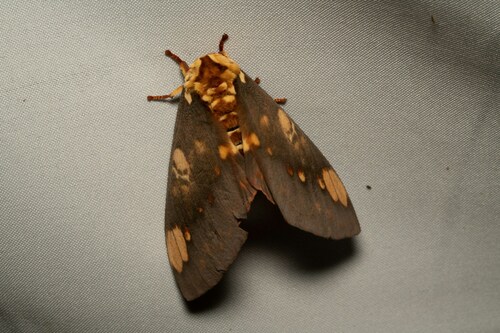
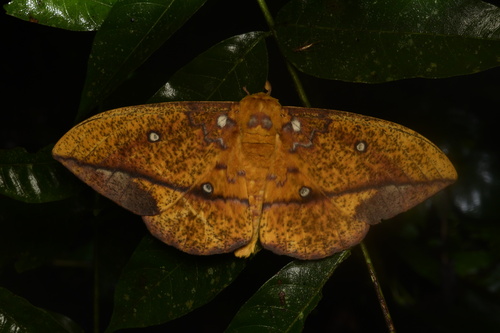
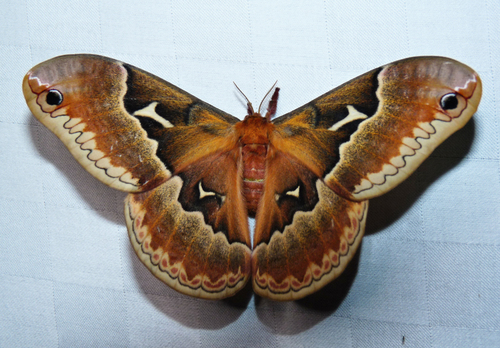
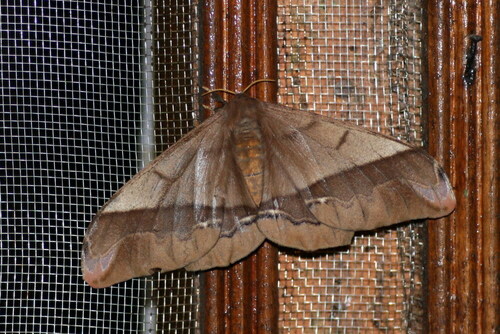
In terms of morphology and identification, young Arsenura armida larvae show aposematism through their bright yellow bodies marked with black rings and red heads. Later instars are darker and duskier than early instars; they have dark brown heads, bodies covered with fine short setae, and black tentacle-like protuberances on the upper surface of their thoracic segments. Thin orange-yellow rings mark the intersegmental membrane. Adults are large, predominantly dull brown moths that prefer to rest with their wings spread, and some adults may display complex patterns. The adult wingspan measures 100 to 120 mm. This giant silk moth is mainly distributed across Central and Southern America, ranging from tropical Mexico to southeastern Brazil. It can be found on Guazuma ulmifolia, Rollinia membranacea, and Bombacopsis quinatum plants. In Costa Rica, it occurs in all wildland ecosystems, from dry forest to very wet rainforest. Giant silk moth caterpillars are well known for being gregarious throughout all stages of larval development. A distinctive feature of the species is the shift in forms of social behavior between early and late instars. In early instars, larvae stay aggregated at all times in different patches and forage nomadically. As larvae mature, the species shifts to using a central foraging location: larvae feed alone at night, and after finishing feeding, they climb back up to the canopy at roughly the same time to rest during the day. Hypotheses have been proposed to explain this behavioral shift. Overall, caterpillar feeding behavior is shaped by the combined effects of phylogenetic history, larval nutritional ecology, larval size or appearance, and defensive ecology. Similar behavioral shifts occur in other species; for example, many swallowtail larvae start as cryptic mimics of bird droppings, then switch to aposematism or aggressive mimicry in later instars. Predation or parasitism is hypothesized to have influenced the grouping behavior and aposematism of this giant silk moth. It is confirmed that late instar larvae are lethally poisonous to predators such as trogon nestlings if ingested. Their bright coloration, made more noticeable by the large number of caterpillars grouped in a single larval mass, acts as a visible deterrent to potential predators.