About Arripis truttacea (Cuvier, 1829)
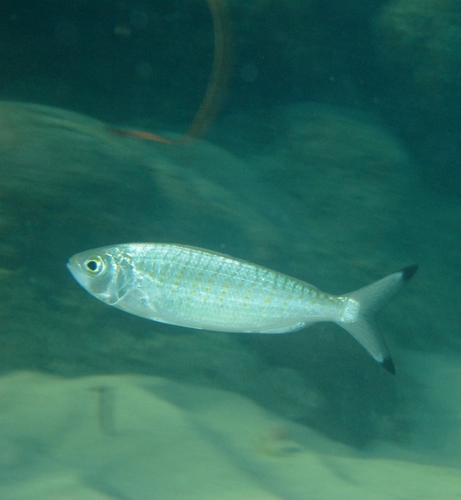
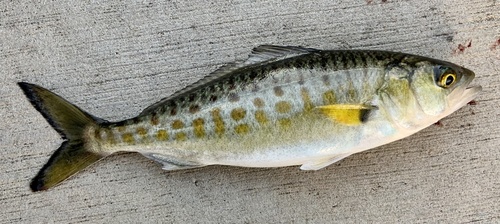
Arripis truttacea (Cuvier, 1829) has a streamlined, moderately deep, slightly elongate body that is a little compressed, with a relatively narrow caudal peduncle and a moderately small head. Its eyes are quite small, and larger individuals have obvious transparent adipose tissue growth on the anterior and posterior edges of the eye. A series of fine serrations runs along the lower edge of the preorbital bone, but these serrations largely disappear in larger fish. The mouth is moderate in size and oblique; its maxilla extends to a level below the centre of the eye. Each jaw holds a narrow band of small pointed teeth. Except for the lower jaw, snout, and area above the eyes, the body is covered in moderately small, very finely ctenoid scales, and larger specimens feel smooth to the touch. The lateral line is almost straight. It has a long dorsal fin, with a slight notch separating its spiny and soft-rayed sections; the spiny section is markedly higher than the soft-rayed section. It has a small anal fin, which is roughly half the length of the soft section of the dorsal fin. The tail is deeply forked. Adult individuals have a greyish green to steely blue back, normally marked with yellow to slate grey spots, and silvery white underparts. The pectoral fin is pale yellowish, and all other fins are translucent. Juveniles are similar to adults but have more numerous spots and dark fin margins. The spiny section of the dorsal fin contains 9 spines and 15-19 soft rays, while the anal fin has 3 spines and 9 to 10 soft rays. The maximum recorded standard length is 96 centimetres (38 in), though the more common standard length is 65 centimetres (26 in), and the maximum published weight is 10.5 kilograms (23 lb). The most consistent difference between this species and Arripis trutta is gill raker count: A. truttacea has 25-31 gill rakers, while A. trutta has 33–40. Arripis truttacea is endemic to the coastal waters of southern Australia, found from Lakes Entrance in Victoria to Kalbarri in Western Australia, and it is rare north of Lancelin, Western Australia. Adult A. truttacea form large schools along exposed beaches and rocky reefs, while juveniles use shallow bays and estuaries as nursery areas. Juveniles are frequently found in Posidonia seagrass beds and in creeks lined with mangroves of the genus Avicennia. Adult schools may also occur in estuaries and deeper offshore waters. This is a carnivorous species that preys mainly on small pelagic schooling baitfish, and it is itself preyed on by seals, dolphins and sharks. Western Australian salmon (A. truttacea) arrive off south western Australia from March onwards to spawn, and they mainly congregate in waters between Cape Leeuwin and Busselton in late autumn and early winter. Their arrival coincides with the peak strength of the eastward flowing Leeuwin Current and associated easterly winds. These currents and winds carry newly hatched larval fish southeastwards. The larvae settle along the entire southern coast of Australia, but the majority are transported to waters off Victoria and Tasmania. They mature in nursery grounds located between South Australia and Tasmania over three to four years, before migrating west to Western Australia, forming schools near Hopetoun and Esperance. After the spawning run ends in mid-winter, adults move back to the south-eastern Western Australian waters.