About Arripis trutta (Forster, 1801)
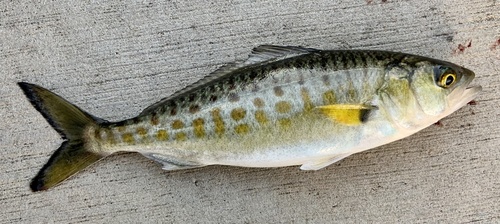
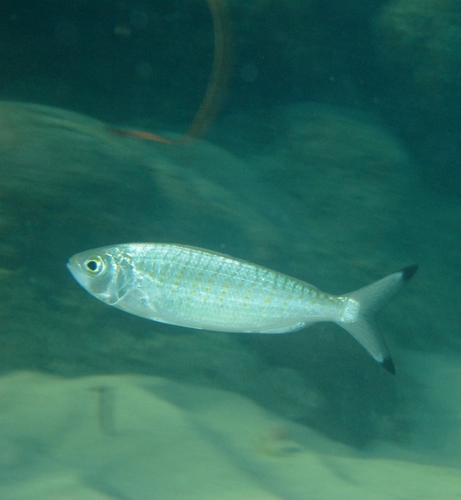
Arripis trutta (Forster, 1801) is a streamlined fish with a long, slender body. A bony ridge of bone sits beneath and in front of each eye; this ridge has obvious serrations in smaller individuals, while larger fish have smooth scales. The lobes of the caudal fin are the same length as the fish's head. Dorsally, this species is dark bluish-green, and ventrally it is silvery white. Juveniles have golden bars on their upper flanks; these break up into large spots as the fish matures. The pectoral fin is vivid yellow, and both the caudal fin and the spiny portion of the dorsal fin have a blackish margin. The dorsal fin has 9 spines and 15–17 soft rays, while the anal fin has 3 spines and 9–10 soft rays. The maximum recorded total length is 89 centimetres (35 in), and the common total length is around 47 centimetres (19 in). The maximum recorded weight is 9.4 kilograms (21 lb). The most consistent difference between this species and Arripis truttacea is gill raker count: A. truttacea has 25–31 gill rakers, while A. trutta has 33–40. A. trutta can be distinguished from Arripis xylabion by its larger tail. Arripis trutta is found in the southwestern Pacific Ocean, mostly around the littoral waters of the Tasman Sea and Bass Strait. In Australia, it occurs from Moreton Bay in Queensland to western Victoria and northern Tasmania, with infrequent records at Kangaroo Island in South Australia. It is also found around Lord Howe Island and Norfolk Island in the open waters of the Tasman Sea. In New Zealand, it is distributed around all coasts, but is more common north of Kaikōura on the South Island. It also occurs around the Chatham Islands and Kermadec Islands east of New Zealand. Arripis trutta is a migratory fish that may swim long distances, sometimes thousands of kilometres. Adults congregate in very large schools off oceanic beaches and exposed coastal areas, and will enter rivers. Juveniles live in smaller schools in more sheltered areas such as bays and estuaries, and these habitats are mostly found in the more southerly parts of the species' range. It is a carnivorous, highly visual predator that feeds mainly on small pelagic fish and crustaceans such as krill. During the juvenile phase, it preys on a wide variety of crustaceans and polychaetes. As adults, individuals shift their preferred prey to small schooling baitfish such as pilchards, sprats and anchovies. There is some evidence that the diet of A. trutta has undergone a marked shift since the late 20th century. Studies conducted in the 1950s and 1960s found that adults fed largely on krill and squid, animals associated with cooler waters. Early 21st century studies have shown that the main prey taken is now small pelagic baitfish. This shift is thought to result from long-term changes in the East Australian Current, which brings warmer waters from the Coral Sea and has extended farther south since the 1990s. This multi-decadal southward penetration of the East Australian Current is thought to be one of the more obvious indications of global warming, and the recorded diet change in A. trutta forms a biological record of oceanic warming. Arripis trutta are preyed on by larger marine predators such as seals, dolphins and sharks. When feeding, their schools push smaller prey fish toward the surface, making the prey accessible to seabirds. Because of this, the species has an important ecological role in facilitating energy transfer among the upper levels of the pelagic food chain in inshore ecosystems. An example of this association is the white-fronted tern (Sterna striata), which has the colloquial name "kahawai bird" because it often feeds on shoaling fish alongside kahawai, gulls and shearwaters. Fishers searching for kahawai schools to troll look for flocks of feeding white-fronted terns that gather with the predatory fish. The Australian population of this species spawns in the surf zone between Lakes Entrance in southeastern Victoria and Bermagui on the South Coast of New South Wales, during late spring and summer. Individuals first spawn when they are around four years old, after reaching a length of 39 centimetres (15 in). This species can live for up to 26 years.