About Arripis georgianus (Valenciennes, 1831)
Arripis georgianus, commonly known as the Australian herring, has a streamlined, moderately deep, slightly elongate, somewhat compressed body with a relatively thin caudal peduncle. It has a quite small head with rather large eyes and a moderately large oblique mouth, where the maxillae extend to the level of the centre of the eyes. Each jaw holds a narrow band of small, pointed teeth, and the lateral line is almost straight. All of the head and body, except the lower jaw, snout, and area over the eyes, is covered in small, finely ctenoid scales.
Its long dorsal fin has a small notch between the higher spiny section and the soft rayed section. It has a small anal fin that is roughly half the length of the soft part of the dorsal fin. The caudal fin is deeply forked, the pectoral fins are small, and the pelvic fins are moderately sized; their origin sits underneath the centre of the pectoral fin base, and they extend midway to the anus.
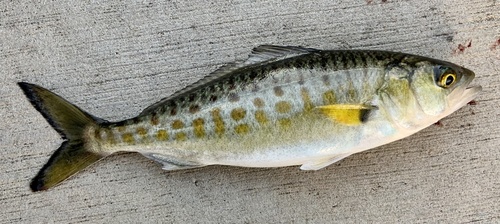
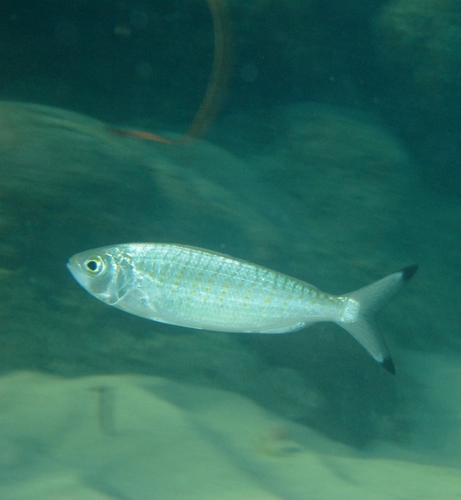
Australian herring are similar to juveniles of the congeneric Australian salmon, and differ from that species by their comparatively larger yellow and black eye and rounder head. This species is silver in colour, with black tips on the tail and gold spots along the upper body. Juveniles have dark golden bars on their flanks. The dorsal fin contains 9 spines and 16 soft rays, while the anal fin has 3 spines and 10 soft rays. The maximum recorded fork length is 41 centimetres (16 in), and most individuals are commonly 25–30 centimetres (9.8–11.8 in) long.
The Australian herring was first formally described as Centropristes georgianus in 1831 by Achille Valenciennes, with the type locality given as King George Sound in Western Australia. When Leonard Jenyns placed it in the new genus Arripis, this was a monospecific genus, making Arripis georgianus the type species of the genus.
Australian herring is endemic to the temperate seas of southern Australia, ranging from the Swan River in Western Australia along the south coast and along the east coast as far north as Forster, New South Wales. It is also found around Tasmania.
Australian herring form large schools in seagrass meadows, off beaches, over reefs, in coastal bays, and in estuaries. They are normally found near the surface, and do not occur deeper than a few metres. They are predators that feed on smaller fishes and some invertebrates that live among weed beds and seagrass meadows.
These fish reach sexual maturity at around 2–3 years of age. Once mature, they move westwards along the Australian coast to an area of the southwestern coast, where they spawn alongside locally resident adults. Spawning takes place between April and June. Female fertility depends on body size: a 20 centimetre (7.9 in) long individual may lay 50,000 eggs, while a 33 centimetre (13 in) female may lay 200,000 eggs in a single spawning season. The eggs, larvae, and juveniles are planktonic, and drift southwards along the western coast of Australia and eastward along its south coast carried by prevailing winds and currents, with the Leeuwin Current being particularly important to this movement. When juveniles reach 30–60 millimetres (1.2–2.4 in) in length, they settle in winter and spring, using nursery sites along the south coast. Some remain close to the spawning grounds along the southern part of Western Australia’s western coast. Geographe Bay appears to be a very important source of recruitment for the west coast population. After spawning, adult fish remain off the west coast of Western Australia and do not return to the south coast. They disperse along the coast, move into estuaries, and range as far north as Shark Bay.