About Arremonops conirostris (Bonaparte, 1850)
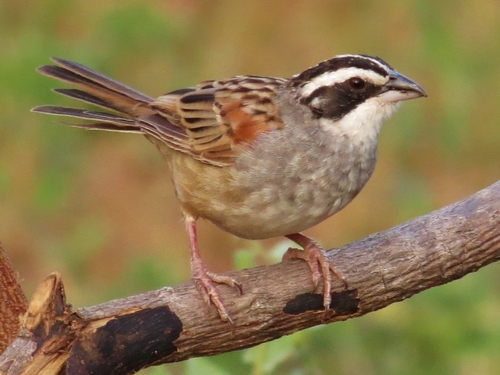
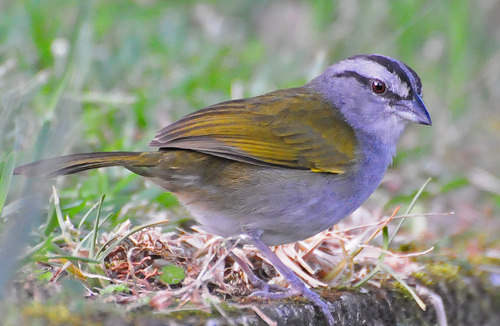
The black-striped sparrow, with the scientific name Arremonops conirostris, is a passerine bird that ranges from eastern Honduras to western Ecuador, northern Brazil, and Venezuela. This American sparrow is common in humid lowlands and foothills up to 1,500 m (4,900 ft) in altitude, where it occupies semiopen habitats including thickets, young second growth, overgrown fields, shady plantations, and gardens. The female builds this species’ large, domed nest from coarse plant material, and the nest has a wide side entrance. Nests are normally placed less than 1 m (3.3 ft) above ground within dense growth, but may be positioned as high as 1.8 m (5.9 ft). Clutches contain two unmarked white eggs, rarely three, which are incubated by the female alone for 12 to 14 days before hatching. The black-striped sparrow is a mainly terrestrial species, measuring 16.5 cm (6.5 in) long and weighing 37.5 g (1.32 oz). Adults have a distinctive appearance: they have a grey head marked with broad black stripes on each side of the crown and narrower black stripes running through each eye. Their upperparts are olive, with yellow coloring at the bend of the wing. Their underparts are dull white, fading to grey on the sides of the breast and to olive on the lower belly. Juveniles have brown stripes on a yellower head, brownish-olive upperparts, and yellow-olive underparts. This species resembles the olive sparrow, but it is larger than the olive sparrow, and their geographic ranges do not overlap. Seven subspecies of black-striped sparrow are recognized. A. c. conirostris (Bonaparte, 1850) is the nominate subspecies that breeds across most of northern South America. A. c. inexpectatus Chapman, 1914 breeds in part of western Colombia; it is small, dull, and brownish-olive on its upperparts. A. c. pastazae Krabbe & Stejskal, 2008 occurs in eastern Ecuador. A. c. richmondii Ridgway, 1898 breeds in Central America, south to western Panama; it is smaller and brighter than the nominate A. c. conirostris. A. c. striaticeps (Lafresnaye, 1853) breeds from central Panama to western Ecuador; it is whiter on its underparts than either the nominate A. c. conirostris or A. c. richmondii. A. c. umbrinus Todd, 1923 breeds in the Maracaibo basin of northern Colombia and Venezuela; it is another small, dull subspecies, but is brighter on its upperparts and slightly larger than A. c. inexpectatus. A. c. viridicatus Wetmore, 1957 breeds on Panama’s Isla de Coiba; it is greyer on the head, breast, and flanks than A. c. striaticeps. The black-striped sparrow produces a metallic churk call. The male’s song, delivered from the ground or a low perch, is made up of whistles and slurred notes following the pattern tsweet-tsweet tsweet-tswee ti-ti-ti, and ends with a trill; the song structure varies between different geographic populations. The black-striped sparrow feeds on insects, spiders, and seeds collected from the ground, and also picks berries and invertebrate prey from low bushes. It is typically seen in pairs, never in flocks, and is a shy and retiring species.