About Arremon taciturnus (Hermann, 1783)
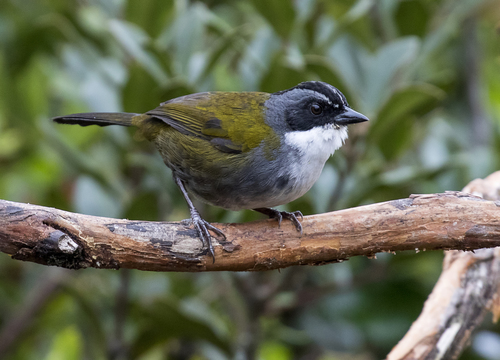
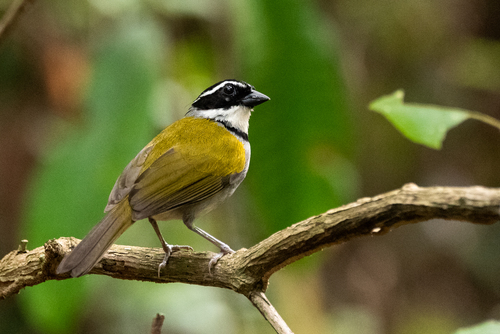
The pectoral sparrow (Arremon taciturnus) is a sexually dimorphic bird that is sparrow-sized as its common name suggests, measuring 15 cm (5.9 in) in length and weighing 24 g (0.85 oz). Its upperparts are pale green, shifting to yellow near the bend of the wing. It has a black head, with white coloring on its throat and as stripes along its crown. Its underparts are white or creamy; males additionally have a broad black band that crosses their breast (the pectoral band that gives the species its name). The beak is also black, and measures roughly 14–15 mm (0.55–0.59 in) long for both males and females. For males and females respectively, tail length ranges 58–60 mm and 64–67 mm (2.3–2.4 in and 2.5–2.6 in), and wing length ranges 74–75 mm and 76–80 mm (2.9–3.0 in and 3.0–3.1 in). The species has a brown iris, and pinkish gray tarsi and toes. Male and female plumage is distinctly different: females have dull olive upperparts instead of bright yellow, a grayish pectoral band, and greyer, darker underparts. The pectoral sparrow is fairly distinct in its native habitat; it is usually the only small forest sparrow with a striped head within its range. It can be told apart from the orange-billed sparrow, whose distribution borders it in eastern Colombia, by the orange-billed sparrow's namesake orange bill and inverted throat color pattern (a black throat with a white stripe). The pectoral sparrow is a non-migratory species. It occurs across most of the Amazon Basin east of the Andes, with the exception of the western area between the Negro and Purus rivers. In addition to the Amazon jungle, it is also found in eastern and northeastern Brazil. It occurs at altitudes up to 1,500 m (4,900 ft) in southern Venezuela, up to 1,000 m (3,300 ft) in southeastern Peru, and up to 1,300 m (4,300 ft) in Bolivia. It inhabits the lowland undergrowth of humid evergreen forests or secondary forests, and occurs only infrequently in lighter woodlands or coffee plantations, most often when these areas are near humid wooded ravines. A 1 pair per 200 hectares (490 acres) pair density has been recorded for the species in Peru.