About Arothron mappa (Lesson, 1831)
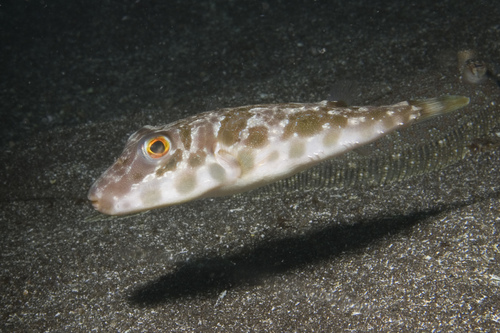
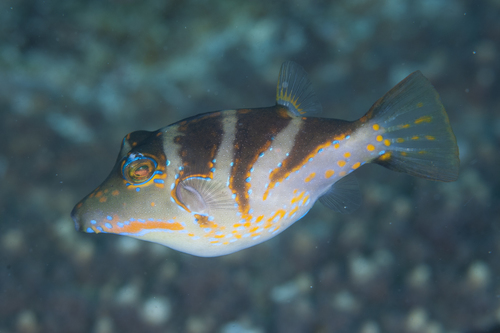
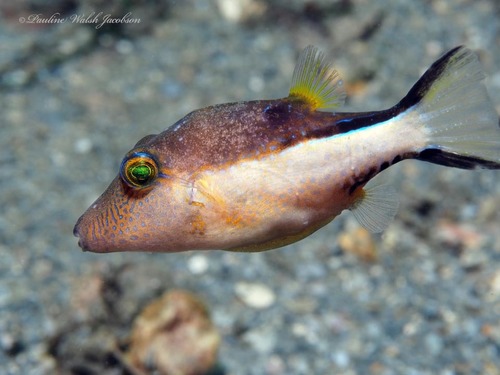
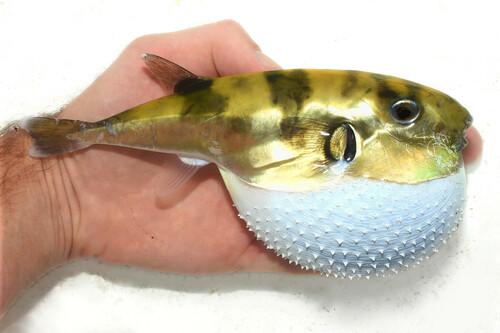
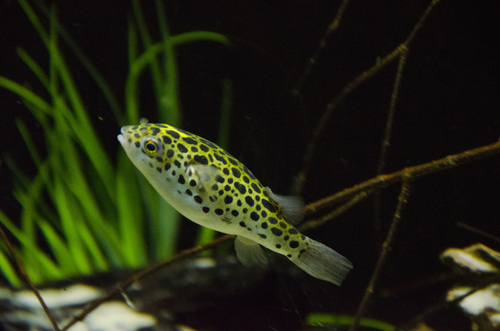
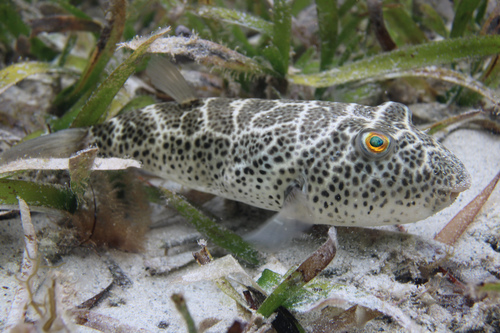
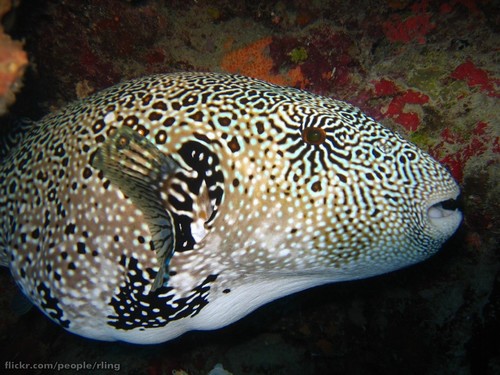
Arothron mappa, commonly called the map puffer, is a medium-sized fish that grows up to 65 centimeters in length. Its body has an oval shape, roughly spherical but relatively elongated. The skin is not covered in scales; instead, most of the map puffer's body is covered in small dermal spines, with the exception of the areas around the mouth, pectoral fin base, and caudal fin base. This species has no pelvic fins and no lateral line. Its dorsal fin and anal fin are small, symmetric, and located at the rear end of the body. It has a short snout with two pairs of nostrils, and its mouth holds four strong teeth that have fused into a sharp-edged beak. These teeth grow continuously throughout the entire lifespan of A. mappa, so they must be constantly worn down by eating hard-shelled prey. The map puffer's base body color is whitish, overlaid with a dense network of broken black, brown, or greenish lines, with radiating lines extending outward from the eye. Depending on the individual specimen, dark or yellowish blotches may appear around the mouth, the symmetrically positioned anus, on the fins, or anywhere else on the body. Arothron mappa lives in tropical and subtropical waters, ranging from the Indian Ocean to the western Pacific Ocean. Adult map puffers are found along deep drop-offs, clear lagoons, and sheltered reefs from the water's surface down to 30 meters in depth. Juvenile map puffers are found on seagrass beds. Courtship in A. mappa starts when a male constructs a large flattened circle in the substrate. He uses his fins to dig and stir up sand particles, then digs geometric valleys and ridges inside the circle to create a complex, maze-like geometric pattern. This structure works both as a mating display to attract females and a nesting site where eggs are laid. When a female A. mappa approaches the nest, the male will swim around and stir up sand to draw the female's attention. If the courtship ritual is successful, the female enters the nest and releases her eggs, which the male then fertilizes. Fertilized eggs stay and develop within the nest until they hatch into a planktonic larval stage. Even though it contains tetrodotoxin, it can be safely eaten by humans when prepared correctly. Several pufferfish species in the family Tetraodontidae are considered delicacies in Japan, and studies have confirmed that the map puffer's flesh is safe for human consumption. The skin, liver, gonads, and intestines of the map puffer should not be eaten, as these organs contain high concentrations of tetrodotoxin. Specialized training is required to properly prepare tetrodotoxin-containing pufferfish for consumption, to avoid contaminating the edible flesh with toxin from the fish's skin and organs. However, farm-raised pufferfish in Japan that are fed a controlled diet are no longer toxic for human consumption; even the fish's liver can be eaten prepared as foie gras without any harmful effects.