About Arnica lanceolata Nutt.
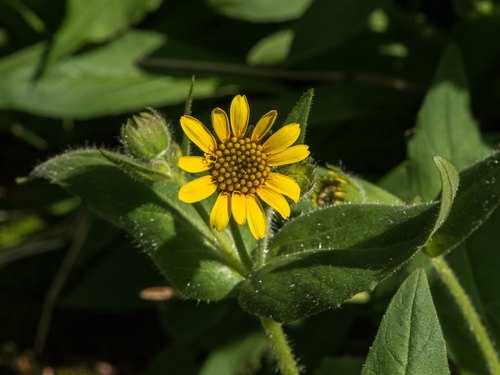
Arnica lanceolata Nutt. is a North American flowering plant species in the family Asteraceae, commonly called clasping arnica or lanceleaf arnica. It has a discontinuous (disjunct) distribution across western and northeastern North America. This is a perennial herb that typically grows from a small rhizome, producing one or more hairy, glandular stems. The stems bear 5 to 10 pairs of oval-shaped, toothed leaves that can reach up to 12 centimeters in length. Its inflorescence is a cluster of several daisy-like flower heads, with a center made up of brownish disc florets and a fringe of yellow ray florets that measure 1 to 2 centimeters long. The fruit is a cylindrical achene covered in hairs, with a light brown pappus at one end. Arnica lanceolata grows in moist locations, including along stream banks and in montane to alpine meadows. There are two recognized subspecies: Arnica lanceolata subsp. lanceolata, found in Quebec, New Brunswick, Maine, New Hampshire, Vermont, and New York; and Arnica lanceolata subsp. prima (Maguire) Strother & S.J.Wolf, found in Alaska, Yukon, Northwest Territories, Alberta, British Columbia, Washington, Oregon, California, Idaho, Montana, Utah, Wyoming, and Nevada.