About Armillaria novae-zelandiae (G.Stev.) Boesew.
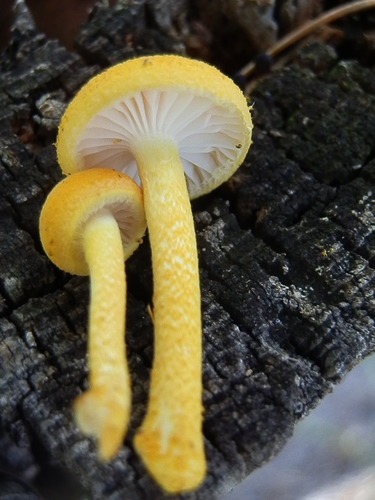
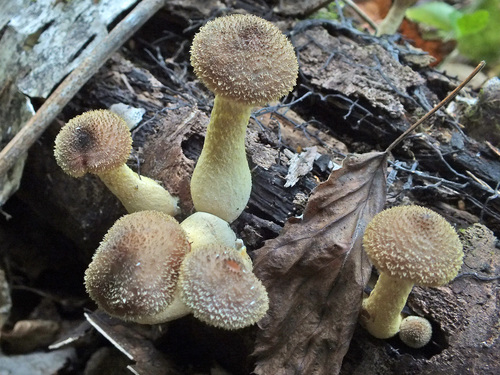
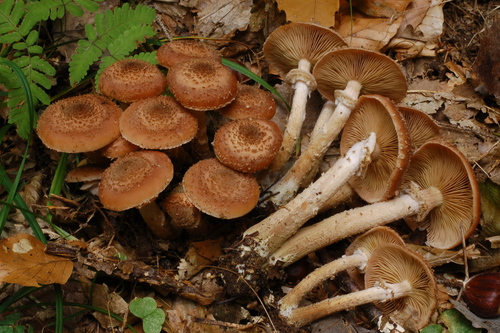
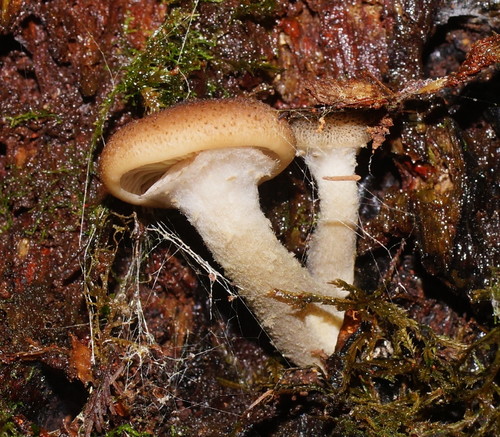
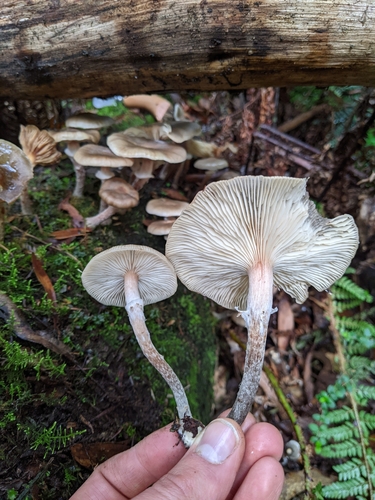
Armillaria novae-zelandiae was first described by Greta Stevenson under the original name Armillariella novae-zelandiae. Its original morphological description notes: the pileus is 3–8 cm in diameter, coloured olive-buff to olive-brown, with very small dull brown scales scattered across its centre. It starts convex with a strongly down-rolled margin, later becoming plane to shallowly concave. When fresh, it is moist with a noticeably striate margin, and becomes matte when dry. Its flesh is creamy white. The gills run decurrent down the stem to a deeply sinuate attachment, are creamy white turning dull fawn, are moderately crowded and include many short gills. The stipe measures 4–7 × 0.4–0.8 cm; it is fawn above the evanescent ring, and brown to dark purplish brown below the ring. The stipe is either smooth or striate, tough, solid, with swollen and united bases. Spores measure 8–9 × 5.5–6.5 μm, are non-amyloid and have rather thick walls. The spore print is white. The pileus of A. novae-zelandiae is sometimes bioluminescent. This species is distributed across three regions: Australasia (New Zealand including the Chatham Islands, Tasmania, Eastern Australia, and Papua New Guinea), South America (Argentina and Chile), and Asia (Indonesia, Malaysia, and the Amami-Oshima islands of Japan). Isolates from New Zealand and Australia are reciprocally monophyletic, but they are classified as the same species due to their similar basidiocarp morphology, vegetative growth characteristics, and sexual compatibility. The South American lineage forms a sister clade to the Australasian clade, while isolates from Asia form a basal monophyletic lineage within A. novae-zelandiae. A study of site conditions in Pinus radiata plantations found that A. novae-zelandiae prefers sites with a mean annual temperature below 13 °C, annual rainfall between 1000 and 1600 mm, and land that was previously forested. Research in Golden Downs Forest detected a topographical effect: infection rates reached 54% in gullies, but only 6% on steep slopes. This topographical effect disappears when soil moisture levels are high. A. novae-zelandiae can survive temperatures as high as 41 °C. In pine forests, as pine root systems grow larger and overlap, disease transfer can occur, allowing infection to spread beyond the original primary infection area. The fungus infects trees that have already been weakened by multiple stresses, including insect defoliation, frost, drought, waterlogging, soil compaction, air pollution, and foliage diseases. The fungus's rhizomorphs colonize these weakened trees, and can colonize an entire root system after severe stress events.