About Armillaria mellea (Vahl) P.Kumm.
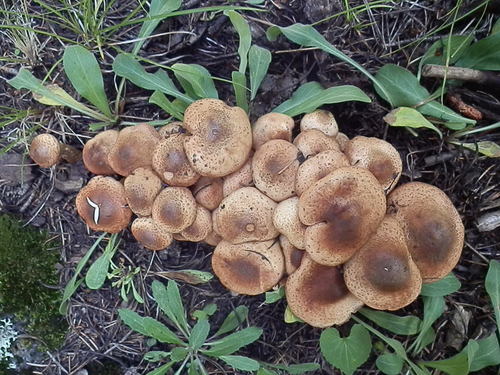
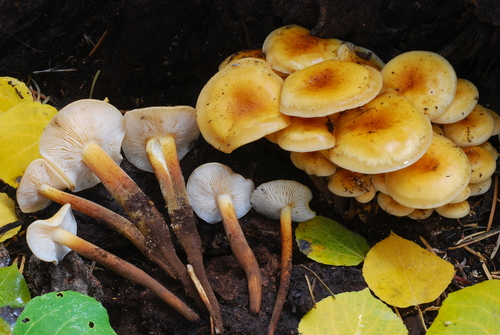
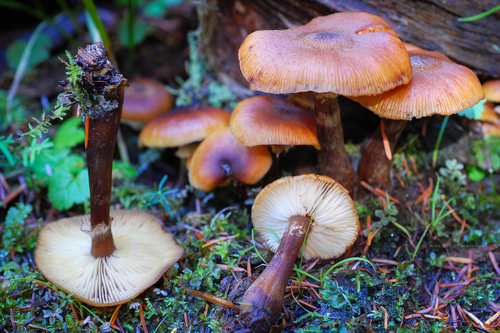
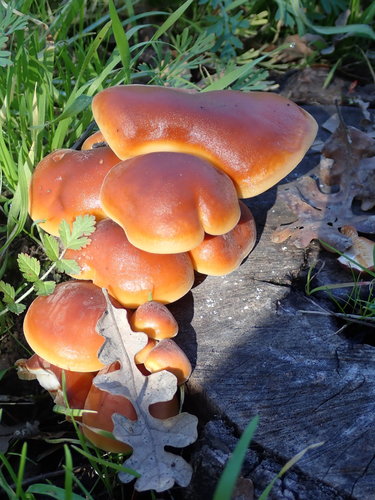
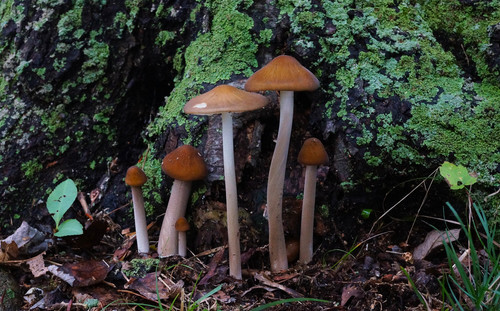
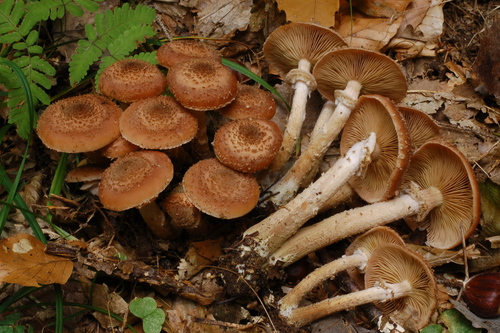
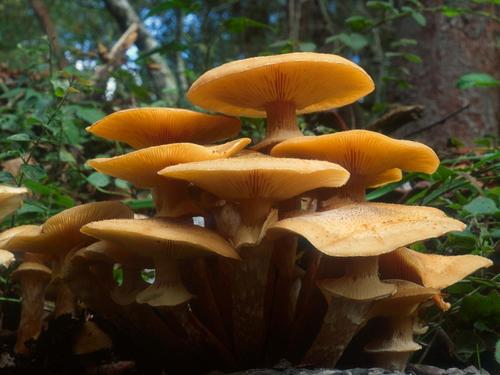
Armillaria mellea (Vahl) P.Kumm. produces basidiocarps with smooth caps 3 to 15 cm (1 to 6 in) in diameter. Caps start convex, become flattened with age and often have a raised central umbo, eventually turning somewhat dish-shaped. At maturity, cap margins are usually arched, and the cap surface becomes sticky when wet. While typically honey-coloured, the fungus varies widely in appearance; sometimes a small number of dark, hairy scales arranged radially are present near the cap center. The gills start white, may develop a pinkish-yellow or other discoloration with age, are broad and fairly spaced apart, and attach to the stipe at right angles or are slightly decurrent. The cap flesh is whitish, with a sweetish odour and flavour that carries a slight bitter tinge. The stipe measures 5–20 cm (2–8 in) long and 0.5–3.5 cm (1⁄4–1+1⁄2 in) in diameter. It has a fibrillose texture, starts firm and spongy, and becomes hollow with age. Cylindrical in shape, it tapers to a point at its base, which fuses to the stipes of other mushrooms in the same clump. It is whitish at the upper end, brownish-yellow lower down, and often has a very dark base. A broad, persistent skin-like ring attaches to the upper stipe; this ring has a velvety margin, yellowish fluff underneath, and extends outward as a white partial veil that protects young gills. Under microscopic examination, spores are roughly elliptical, measure 6–9 by 5–7 μm, are inamyloid, and have prominent short pointed projections called apiculi at the base. The spore print is white, and the spore-producing basidia lack basal clamps. The main body of the fungus grows underground, where a mat of mycelial threads can extend over great distances. These threads are bundled into black rhizomorphs specific to this species. The full fungal body is not bioluminescent, but its actively growing mycelia are luminous. Armillaria mellea is widespread across northern temperate zones, found throughout North America, Europe, and northern Asia, and has been introduced to South Africa. It grows parasitically on a wide range of broadleaf trees, and produces fruiting bodies in dense clusters at the base of tree trunks or stumps. It prefers moist soil and lower soil temperatures, but can tolerate extreme conditions including forest fires, thanks to protection from the soil. It grows in many types of landscapes, including gardens, parks, vineyards, tree production areas, and natural landscapes. It typically forms symbiotic relationships with hardwood trees, conifers, and a small number of herbaceous plants, growing in settings including orchards, planted forests, and vineyards. The fungus infects new hosts via rhizomorphs and basidiospores. Basidiospores rarely successfully infect new hosts, and instead most often colonize woody debris; rhizomorphs, by contrast, can grow up to ten feet long to reach a new host. Infection signs are few and often hard to observe. The most noticeable sign is the growth of honey-coloured mushrooms at the base of an infected plant. Additional signs include white, fan-shaped mycelia and black rhizomorphs with diameters between 1⁄32 and 1⁄8 inch (0.8 and 3.2 mm). These are usually not obvious, since mycelia grow beneath bark and rhizomorphs grow in soil. Infection symptoms are far more numerous: slower plant growth, branch dieback, yellowing foliage, rotted wood at the base and/or roots, external cankers, cracking bark, bleeding stem, leaf wilting, defoliation, and rapid plant death. Leaf wilting, defoliation, and dieback develop after the fungus destroys the host cambium. Armillaria mellea is one of the most common causes of death in trees and shrubs in both natural and cultivated habitats, and causes consistent, substantial losses. Cultivation of A. mellea began with growing its mycelium to support cultivation of Gastrodia elata, a non-photosynthetic plant used in traditional Chinese medicine. This cultivation method has existed since 1994, and uses wood pieces inoculated with the fungus. In 2017, farmers in Heilongjiang successfully cultivated A. mellea to produce fruiting bodies (mushrooms). Two methods are used for fruiting body cultivation: one uses wood pieces, and the other uses bagged growing medium. By 2019, spent myceliated wood left over from Gastrodia cultivation was routinely used to seed new wood for mushroom production. Armillaria mellea is considered a good edible mushroom, though it is not preferred by some people, and its tough stalks are usually removed before use. It is best collected when young and cooked thoroughly. Specimens growing on buckeye or hemlock can cause gastrointestinal upset. Its flavour is described as slightly sweet and nutty, and texture ranges from chewy to crunchy depending on preparation method. Parboiling the mushrooms before eating removes the bitter taste found in some specimens and may reduce the amount of gastrointestinal irritants. One guide notes that A. mellea must be cooked before consumption. Drying preserves and intensifies the mushroom’s flavour, though reconstituted mushrooms typically become tough to eat. A. mellea mushrooms can also be pickled or roasted. Researchers have studied various nutritional components of A. mellea, including protein, carbohydrates, fat, amino acids, and crude fiber. Fruit bodies contain large amounts of carbohydrates, including polysaccharides such as glucans and glycogen, monosaccharides, disaccharides such as trehalose, sugars, and sugar alcohols such as mannitol, plus chitin. The mushroom is rich in protein and carbohydrates and low in fat, which makes it suitable as a dietary component for people with hypertension and atherosclerosis. In addition, its high crude fiber content may help control diabetes and obesity. Indigenous peoples have also used the mushroom medicinally as a laxative.