About Armillaria limonea (G.Stev.) Boesew.
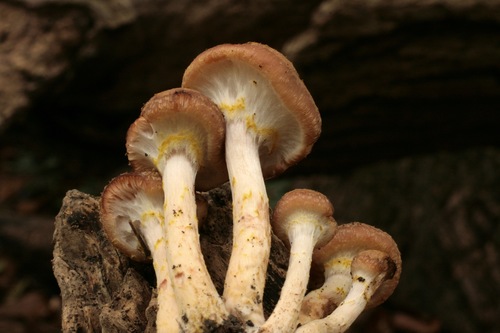
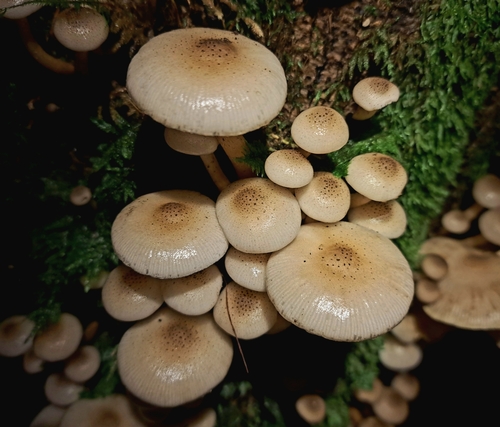
The scientific name of this fungus is Armillaria limonea (G.Stev.) Boesew. It was originally described as Armillariella limonea by Greta Stevenson, whose original morphological description reads as follows: Pileus 8–13 cm in diameter, lemon yellow, covered thickly with dark brown tufted scales at the center, with sparser scale coverage toward the margin. It is dry, convex at first with a strongly down-rolled margin, and becomes almost flat with a wavy edge. The flesh is firm and white. The gills are sinuately decurrent, moderately crowded, creamy white, and become stained pinkish fawn. The stipe measures 10–15 × 1–1.5 cm, it is light brown above the substantial floccose ring, and darkens to brown or olive green below the ring. The stipe surface is velutinate, sometimes has a few tufted scales, it is solid, tough, and slightly bulbous at the base. Spores measure 7–8 × 5–6.5 μm, are non-amyloid, and have moderately thick walls; the spore print is white. The pileus of A. limonea can sometimes be bioluminescent. This fungus is endemic to Aotearoa New Zealand, where it occurs in the North Island and the northern part of the South Island.