About Armases cinereum (Bosc, 1801)
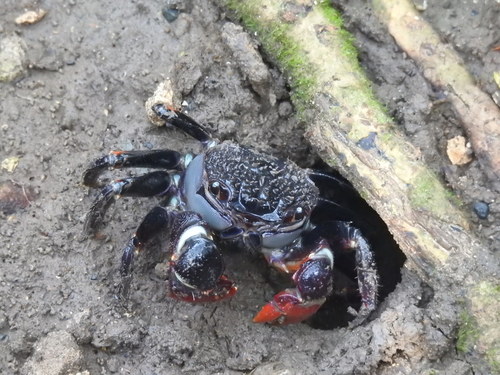
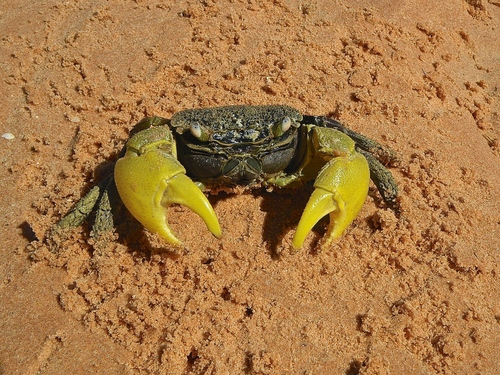
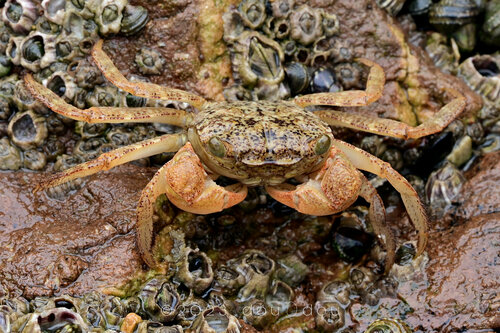
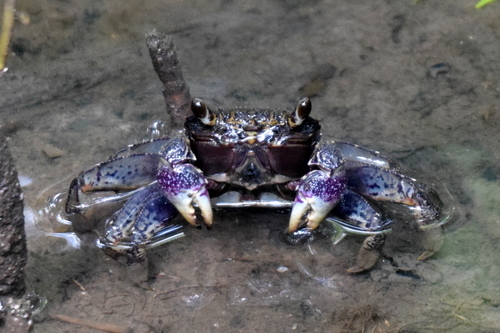
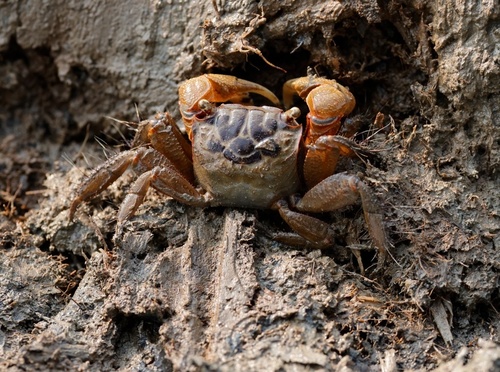
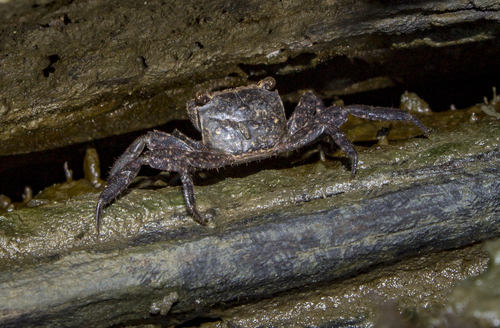
The genus Armases is defined by a mostly equatorial smooth carapace, which may be slightly wider than long or slightly longer than wide. A distinct row of hair occurs on the carapace’s lower margin, and the second walking legs have no pubescence. Armases can be told apart from members of other genera like Sesarma or Sarmatium by its carapace having laterally parallel margins on each side of the body. This gives Armases cinereum its characteristic square shape, which is the origin of its common name squareback marsh crab. Like most decapod crabs, Armases cinereum is vertically compressed, with the carapace making up most of its body. The eyes sit at the top of eye stalks, the abdomen and thorax are located under the carapace, there are four walking legs on each side of the carapace, and one claw on each side positioned anterior to the legs. Armases cinereum (also commonly called the wharf crab) is useful for studying trophic dynamics in coastal habitats, because it reaches high local abundance in both saltmarsh and mangrove habitats, occurs across an elevation range from subtidal to supratidal, and has wide-ranging mobility that spans the mangrove-upland ecotone. The wharf crab has a wide distribution across temperate to tropical coastal environments, and occurs at high density in the coastal areas where it lives. Its range extends from the Chesapeake Bay area, down and around coastal Florida, and west along the coast all the way to Veracruz, Mexico. This species is most often found in intertidal zones and can occur up to 50 meters inland, and it can thrive in a variety of coastal habitats. Common habitats include Spartina (marsh grass) marshes and Rhizophora (mangrove) swamps. Within these habitats, it prefers to live among and under tide-borne rocks and debris. Due to its high population density in coastal environments, wharf crabs can be used as indicators of local habitat conditions. While the wharf crab is often classified as a detritivore, it is highly omnivorous and supplements a detritus-based diet with microscopic insects and invertebrates. In mangrove habitats, wharf crabs are a key omnivore component of the local food chain, functioning as carnivores, herbivores, and detritivores. Examples of foods eaten by wharf crabs in mangrove habitats include insects, partially decomposed Avicennia (black mangrove), and leaves from mangroves or other maritime vegetation. When feeding on plant matter, wharf crabs prioritize softer plants over plants with tougher outer tissue. When both plant and animal food sources are readily available, wharf crabs will choose animal prey. The diet of Armases cinereum matches directly to the environment it occupies and the prominent food available in that environment. As a result, this diverse diet allows the species to maintain relatively high population densities across a broad range of coastal ecosystems. Crab reproduction happens through spawning, in which eggs are released from the oviduct onto the female crab’s abdomen. The spawning season for Armases cinereum typically falls between March and July. Species in the genus Armases are ovigerous, meaning females carry their eggs while the embryos develop. A single brood of Armases cinereum contains between 2,000 and 12,000 eggs. The number of eggs produced depends on fecundity, which is proportional to the size of the female producing the eggs. Fecundity also reflects the total energy an individual must invest to produce a brood of eggs; eggs are energetically expensive to produce, and the ovigerous lifestyle adds additional energy expenditure. When eggs hatch, planktonic crab larvae called zoea emerge. Zoea are characterized by a large spine positioned on their dorsal side. Zoea grow and molt several times before progressing to the next life stage, called the megalopa stage. In the megalopa stage, eyes develop on eyestalks, the carapace forms, and the abdomen extends outward posteriorly from the carapace. After the next molt, the crab becomes a juvenile that matches the adult form, and its larval life stages are complete.