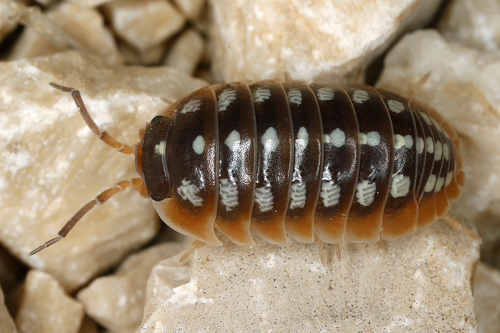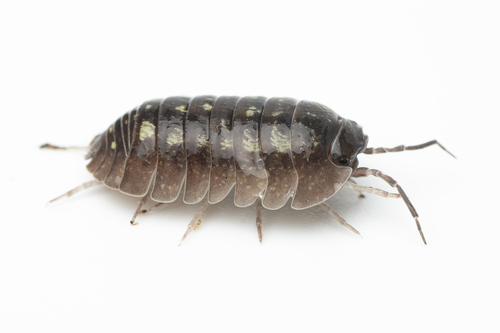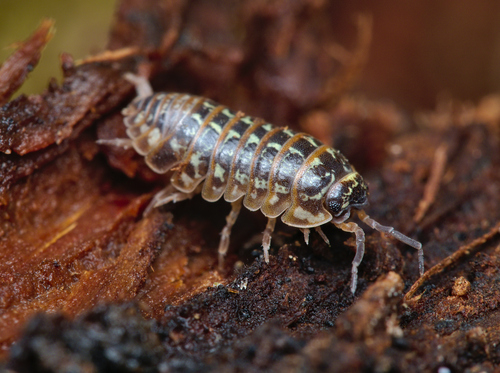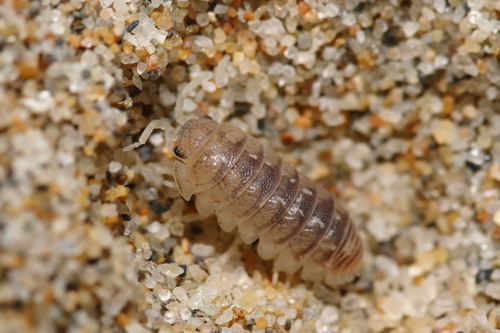
About Armadillidium vulgare (Latreille, 1804)
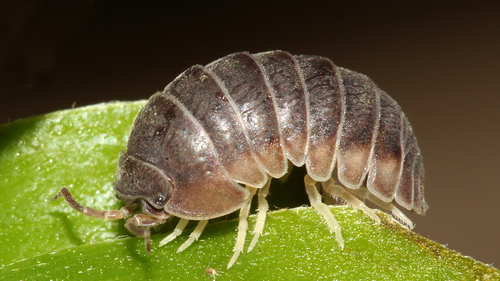
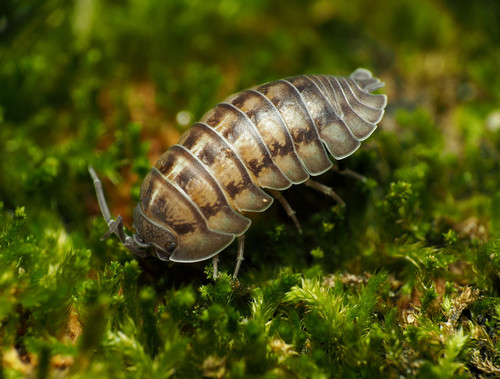
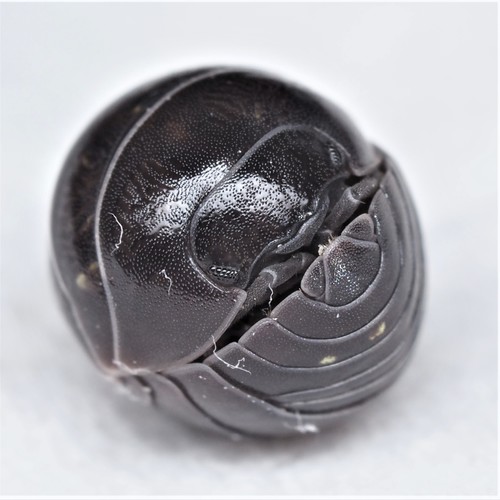
Armadillidium vulgare can grow up to 18 millimetres (11⁄16 in) long, and can roll into a tight ball when disturbed. This ability, combined with its overall appearance, gives it the common name pill-bug, and can lead to confusion with similar pill millipedes like Glomeris marginata. It can be told apart from two related species, Armadillidium nasatum and Armadillidium depressum, by the shape of its rolled ball: A. nasatum and A. depressum leave a gap when they roll up, while A. vulgare does not. The native range of A. vulgare covers Europe, with particularly widespread occurrence in the Mediterranean Basin. In the United Kingdom, it is very common in southern and eastern England, but is only found in coastal areas in the north of the country. In Ireland, it is common in the south and east, but rarer in the north and west. A. vulgare has been introduced to many areas of North America, where it can reach population densities as high as 10,000 individuals per square metre (900 individuals per square foot). It is now one of the most abundant invertebrate species in California coastal grassland habitats. It has also been introduced to other locations across the world, though these introductions are less widespread than in North America. Compared to many other woodlouse species, A. vulgare can tolerate drier conditions. It is restricted to calcareous soils or coastal areas. It feeds mainly on decaying plant matter, and also grazes on lichens and algae that grow on tree bark and walls. It regulates its body temperature through behavioural changes: it prefers bright sunshine when temperatures are low, and stays in shaded areas when temperatures are high. Temperatures below −2 °C (28 °F) or above 36 °C (97 °F) are lethal to this species. A. vulgare is less affected by cold overnight, and may enter dormancy during winter to survive temperatures that would otherwise kill it.