About Armadillidium maculatum (Risso, 1816)
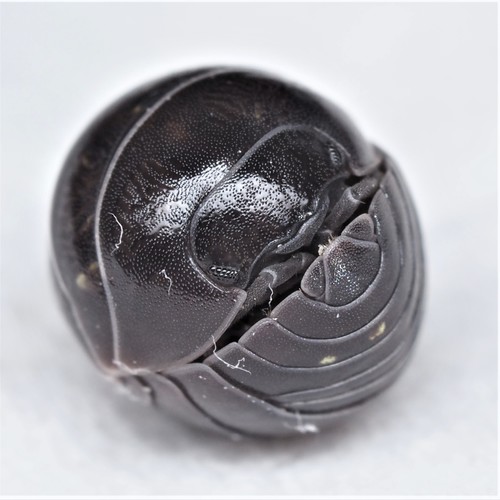
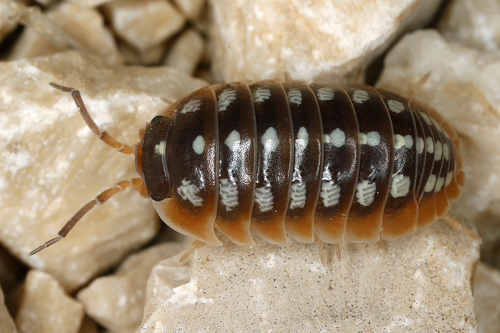
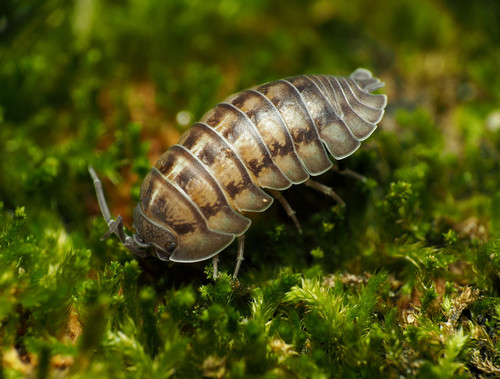
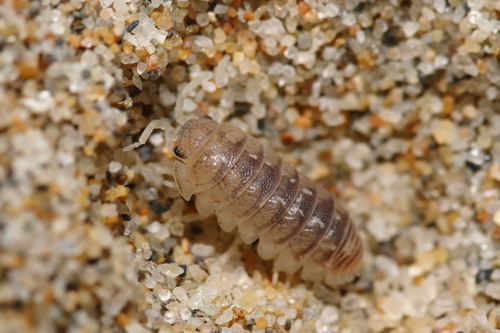
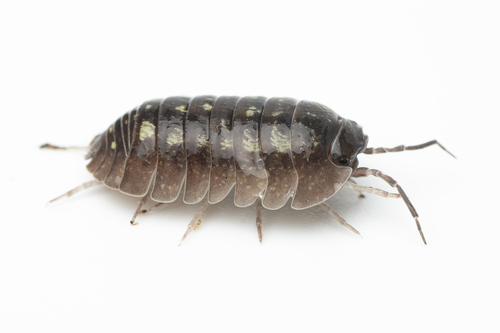
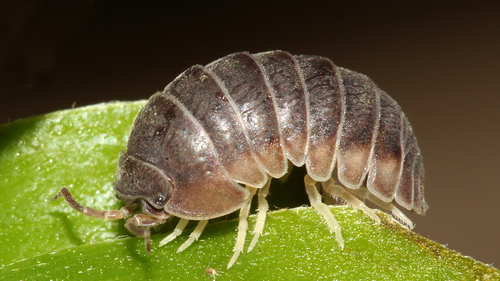
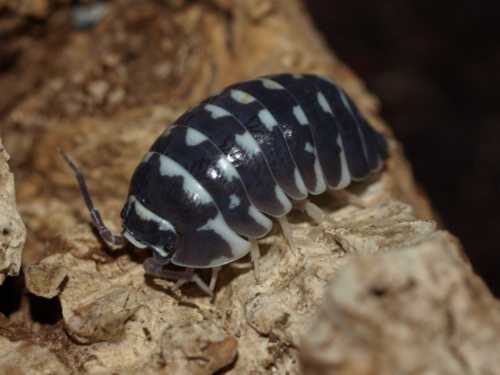
Armadillidium maculatum is an average-sized member of its genus, reaching a maximum size of 18 millimeters, or 11/16 of an inch. Like other members of its family, it can conglobate (roll into a ball) when disturbed, or to conserve moisture. Its striped appearance is thought to be an example of Batesian mimicry; it mimics the pill millipede Glomeris marginata, which secretes noxious chemicals and is native to the same geographic range. Like all other isopods, Armadillidium maculatum has 7 pairs of legs and 7 main body segments (the pleon). As an arthropod, A. maculatum has an exoskeleton that it must shed (molt) as it grows. Unlike most other arthropods, A. maculatum sheds its exoskeleton in two separate halves, one at a time — a process called biphasic molting. It is theorized that isopods molt this way to maintain partial mobility while they are molting and in a vulnerable state. After mating, a female keeps fertilized eggs in an egg-pouch called the marsupium, located on the underside of her body. After a few weeks, the eggs hatch from the marsupium into mancae, with as many as a hundred offspring produced at a time. Clutch size estimates vary based on the age and size of the individual female. The species epithet "maculatum" comes from the Latin term "maculatus", which means "spotted". Armadillidium maculatum is native to a small range in southeastern France. Unlike many of its related species, such as Armadillidium vulgare, it has not been introduced to other regions of the world. It has a much wider distribution as a pet and vivarium cleaner. Like other woodlice, it can be found under stones, in leaf litter, under rotting logs, and in any location that retains enough moisture to prevent desiccation, because the species needs moisture to breathe. Like other woodlice, Armadillidium maculatum is a detritivore that feeds on decaying organic material. It feeds mainly on fallen hardwood leaves and decaying hardwood. Like other members of its genus, it also feeds on fresh plant matter, lichens, tree bark, and algae. Like all other woodlice, it breathes through modified gill-like organs called pleopodal lungs, and requires some moisture to breathe. However, it will drown if kept submerged in liquid for extended periods of time. These gills can be identified as white patches located behind the 7th and final pair of legs. Like other members of its genus, it can withstand drier environments than many other isopods.