About Armadillidium album Dollfus, 1887
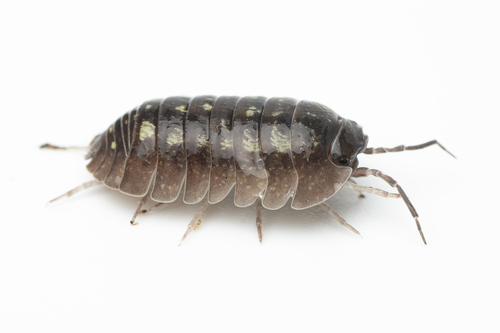
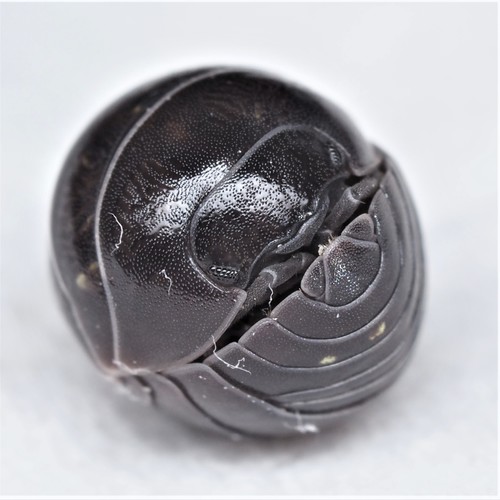
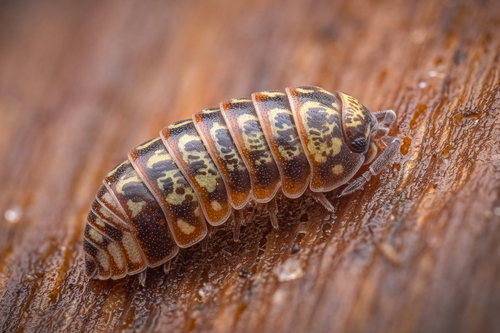
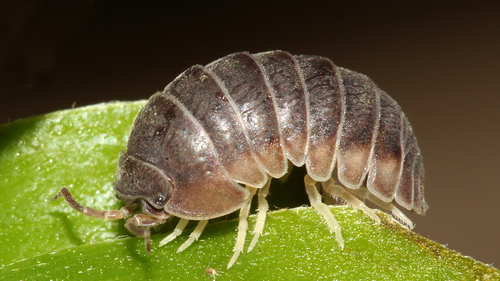
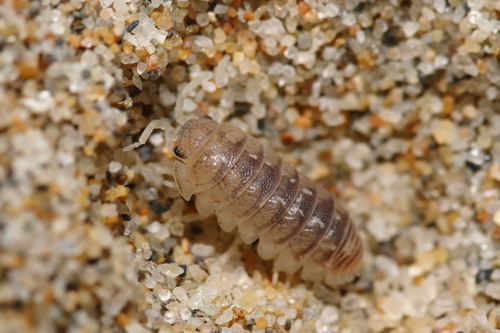
Armadillidium album Dollfus, 1887 reaches a maximum length of 7 mm and a maximum width of 5 mm, and has pleopodal lungs. This species is poorly pigmented, with characteristic mottled sandy colouration on its exoskeleton. When disturbed, A. album only partly rolls up, leaving a few pairs of legs protruding to grip the underlying substrate. The triangular plate on the anterior surface of the frontal epistome is either flat or slightly concave. Its upper margin only protrudes slightly above the dorsal surface of the head, forming an almost straight line. The lower lateral margins of the frontal triangle are sharply edged and concave, and meet at a sharp angle to form a vertical ridge. This triangular structure extends past the eyes, creating a visible narrow ridge along the frontal margin of the head when viewed from above. There is a narrow fissure between the triangular plate and the head. Scattered short hairs grow along the upper margin of the triangle. The head has a strongly backward-curved frontal line, which becomes less distinct toward the sides. It has distinct eyes with black pigment, containing approximately 12 to 15 ocelli. The antennal lobe of the head has a bluntly angular anterior margin. The antennae are relatively short, curving backward and do not reach the end of the first free thoracic segment. The antenna's flagellum is made up of two joints, and the ultimate joint is roughly three times longer than the first. The upper surfaces of the head, thoracic and abdominal segments, and the telson are covered in many minute tubercles, often arranged in longitudinal rows. Each tubercle has a short, stout seta at its top. The epimerae, which are narrow plates on the segments, do not have tubercles, but do have microscopically small grooves arranged in a reticular pattern that is most prominent on the epimerae. The first free thoracic segment has a slightly upward-curved anterior part of the epimera, and its posterolateral angle is somewhat extended with a rounded tip. This feature distinguishes Armadillidium album from A. pulchellum, where the posterolateral angle of the first free thoracic segment is truncate. The posterolateral angles of the following thoracic segments are broadly rounded on the anterior segments, and become more rectangular on the posterior segments. The anterolateral angle of the second to fifth free thoracic segments is bluntly rounded, while the sixth and seventh segments have a rectangular anterolateral angle. The lateral margins of the thoracic segments are slightly thickened. The abdominal segments are roughly equal in length, with rectangular anterolateral and posterolateral angles on their epimerae. The telson is distinctly broader than it is long, with straight or slightly convex lateral margins. The posterior margin is also straight or slightly convex, while the posterolateral angles are bluntly rounded. The posterior margin of the uropodal exopod is slightly convex and has a small incision that holds a hair or small spine that is stronger than the other hairs along the margin. Tubercles are often present on the upper surface of the exopod. The endopods, which are typically short, are often concealed under the telson. In males, the ischium of the seventh pereiopod has a straight lower margin with several short spinules. The ischium widens rapidly before the distal end, and carries two spines on the apex of this widened part, with a third spine located some distance before the other two. Scattered hairs grow on the upper margin of the ischium. In male A. album, the exopod of the first pleopod is broadly leaf-shaped with a broadly rounded anterior margin. The inner part of the posterior margin ends in a blunt point. The endopod of the first pleopod is long and regularly curved outward, with a blunt, irregularly shaped apex. Armadillidium album has a wide distribution across European coasts, occurring in both Temperate and Mediterranean climates. It has been recorded in coastal habitats of Belgium, France, Greece, Ireland, Italy, Portugal, Spain, the Netherlands, and the United Kingdom. It is also found on the Azores Islands, Balearic Islands, Sardinia, Sicily, and the island of Corsica. This species is strongly associated with undisturbed coastal sand dune habitats, particularly those with a specific sand grain size. Though it occurs less commonly in salt marshes, its preferred habitat is relatively undisturbed sandy areas. A. album is often found in close association with storm strandline debris, can be seen clinging to the underside of driftwood, taking shelter in crevices, or burrowing 20–30 cm deep into the underlying sand. The species is highly tolerant to immersion in saltwater, and lives in the supralittoral zone. Armadillidium album reproduces sexually, with a reproductive period in summer. Reproduction happens when individuals are around 12 months old. The average number of eggs carried by a female is eight. Offspring are released from the marsupium brood pouch and require one year to mature into adulthood. The average lifespan of the species is two years, and each female can produce a maximum of two broods.