About Aristotelia serrata (J.R. & G.Forst.) W.R.B.Oliv.
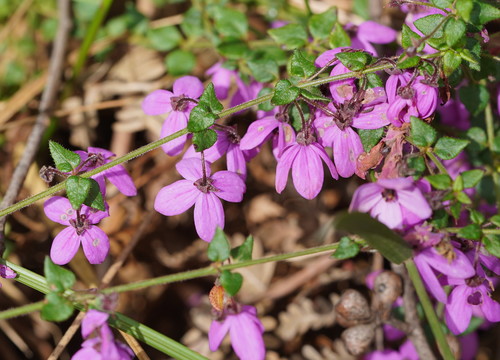
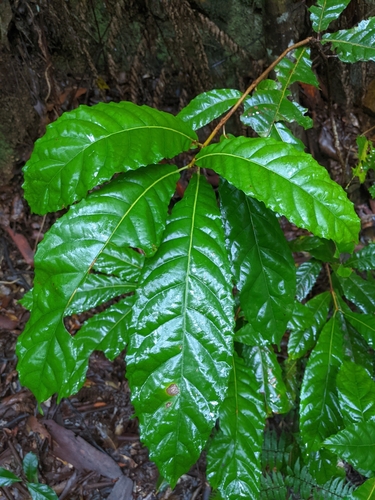
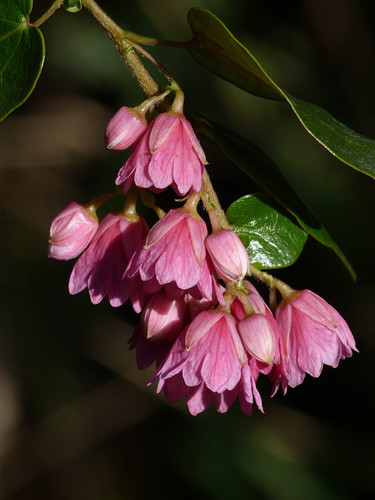
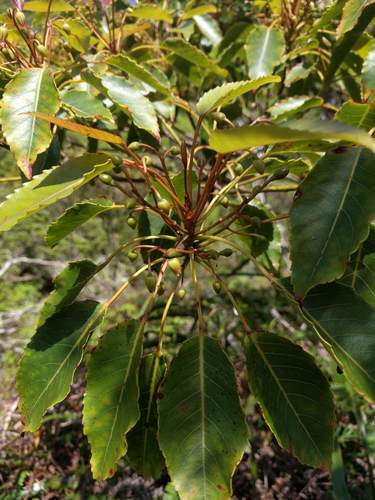
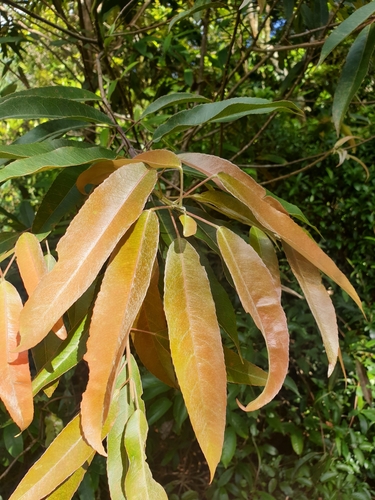
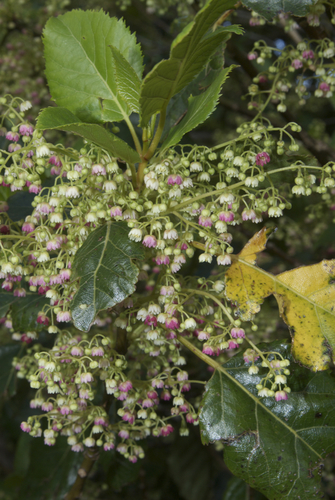
Aristotelia serrata, commonly called wineberry, is a dioecious small tree species that reaches up to around 10 metres (30 feet) in height, with a trunk that can grow up to 30 cm (10 in) in diameter. Its bark is smooth, grey or pale brown, and marked with flat lenticels, while its branchlets range from light to dark red. Leaves are typically arranged oppositely or nearly oppositely; they have slender, greenish or pinkish petioles up to 50 mm long. The thin, smooth leaf blades are broad-ovate, sharply serrated, and measure 5 cm–12 cm × 4 cm–8 cm (2 in–5 in × 2 in–3 in). The upper leaf surface is light or dark green, with a paler lower surface. This species may be semideciduous, and is described as fast-growing and short-lived. Its flower clusters form panicles 6–10 cm (2–4 in) long, with flowering occurring between September and December. Individual flowers are 4–6 mm in diameter, growing on 5–10 mm long pedicels. The pink sepals are roughly 3 mm long, while the petals are about 9 mm long and range in color from white to light pink to red. Flowers have numerous stamens. Fruiting takes place from November to January. The fruits are fleshy, globe-shaped berries that are bright red to black, and measure 5 × 4 mm. Seeds are between 1.9 and 3.1 mm long. A. serrata has a diploid chromosome count of 28. This species is endemic to New Zealand, where it is common across the North Island, South Island, and Stewart Island, though it grows less commonly in drier areas of the country. In 1889, New Zealand botanist Thomas Kirk called it "one of the commonest plants in the colony" in his work The Forest Flora of New Zealand. As of 2023, its conservation status under the New Zealand Threat Classification System is "Not Threatened", and it was assessed as "Least Concern" on the IUCN Red List in 2025, with an unknown population trend. A. serrata typically grows in lowland to montane environments, reaching a maximum elevation of 1,050 m (3,000 ft) above sea level. It has colonial growth habits, freely colonizing disturbed sites, particularly after forest clearance, fire, tree fall, or storm damage. It is commonly found on fertile, well-drained soils on young terraces, alluvial fans, recently disturbed areas, and older terraces. The fruits of A. serrata are dispersed by frugivorous fruit-eating animals, most commonly birds. A 1995 study by Burrows recorded consumption of A. serrata fruit by native silvereyes (Zosterops lateralis), kererū (Hemiphaga novaeseelandiae), and New Zealand bellbirds (Anthornis melanura). Other native birds including kākā (Nestor meridionalis) and tūī (Prosthemadera novaeseelandiae) have also been recorded feeding on the fruit. A. serrata acts as a host plant for two endemic New Zealand moths, Aenetus virescens and Declana floccosa, the beetle species Oemona hirta, and the aphid Paradoxaphis aristoteliae. Its leaves contain high amounts of phenols, which makes them especially attractive to introduced possums, and the leaves are also freely eaten by cattle, deer, and goats. This species can tolerate areas with low soil moisture. As a dioecious species, each individual A. serrata plant is either male or female. Pollination is thought to be carried out by birds and insects. The flowers have no scent and are similar in size on both male and female plants. A. serrata flowers change color from white-pink to dark red, possibly as an adaptation to better attract pollinators. The flower nectar is consumed by stitchbirds (Notiomystis cincta), while native weevils consume the pollen.