About Aristotelia fruticosa Hook.fil.
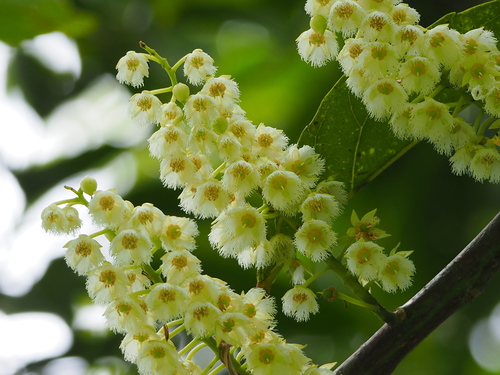
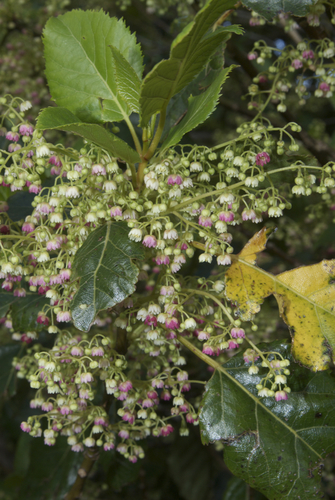
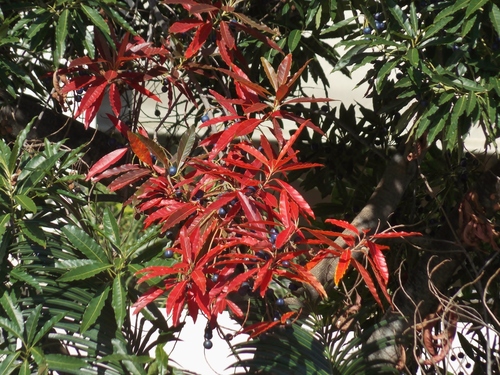
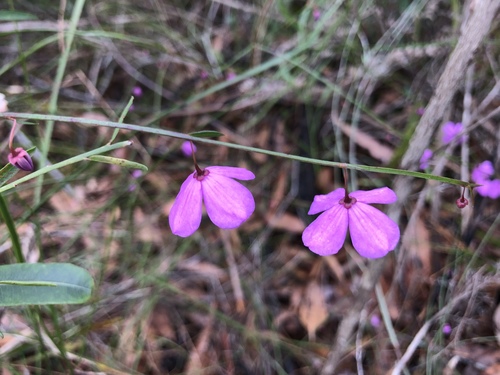
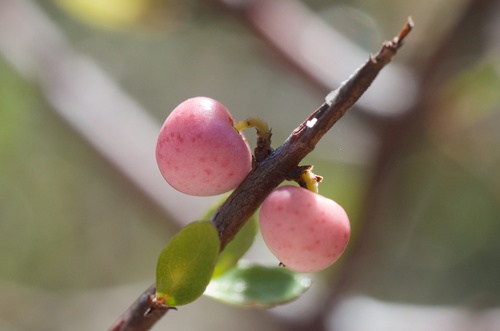
Aristotelia fruticosa Hook.fil. is an upright divaricating shrub that grows up to 2 metres tall. This species is heteroblastic, meaning it changes leaf shape as it matures. As a juvenile, this twiggy shrub grows leaves of varying shapes and sizes arranged in opposite pairs or clusters; a single individual can display multiple leaf shapes at once, or can bear just one leaf shape per plant. Juvenile leaves may be narrow and lance-like (9–15 mm long), egg-shaped (5–7 mm long), or a combination of the two forms. Mature leaves grow into an obcordate shape (heart-shaped, with the tapered end attached to the stem) along the plant's reddish-brown stems, averaging 12 mm long and 4 mm wide. Mature leaves are thin and leathery, with a shiny dark green upper surface and a contrasting light green underside where leaf veins are clearly visible. Aristotelia fruticosa is dioecious: while flowers of both sexes look broadly similar, they have distinct structural features. Flowers of both sexes grow to a few millimeters in diameter, and range in color from cream-white to pink and red. Like the leaves, petals have 1–4 rounded teeth at the tip; each flower has 4 sepals, and all flowers grow in clusters. Male flowers produce 4–6 pollen-bearing stamens, while female flowers grow a two-lobed stamen. After pollination, female flowers develop into small clusters of berries up to 5 mm in diameter, which ripen between March and April. These bitter, opaque berries share the same color range as the flowers, and come in matte pink, red, cream-white, and black. Each berry produces four angled, not fully round, seeds. Aristotelia fruticosa is endemic to New Zealand, found only from 37°30’S south through the midpoint of the North Island, and across the entire South Island and Stewart Island. Specific locations it occupies include the southern and western side of Mt Ruapehu and its volcanic plateaus, Tongariro tephra, the North Island dividing range, the eastern side of the Southern Alps, all of Northwestern Fiordland, South Otago, and central Stewart Island. This species is scattered across many regions from montane to subalpine zones, growing in grasslands, shrublands, subalpine forests, and fellfields at altitudes ranging from 450 m to around 1,700 m. Botanist Cockayne recorded it from a wide range of environmental settings: wet and dry forests dominated by mountain beech (Fuscospora cliffortioides) or silver beech (Lophozonia menziesii); sub-alpine mixed forests dominated by pāhautea (Libocedrus bidwillii) and mountain tōtara (Podocarpus laetus); dry bog forests dominated by stands of mountain toātoa (Phyllocladus alpinus). Cockayne also notes that sub-alpine shrubland dominated by veronica is a common habitat, where shrubs are often covered in lianes; it also grows in cuppressoid-podocarp scrub dominated by bog pine (Halocarpus bidwillii) and pink pine (Halocarpus biformis). As a transitional shrub, it often grows successionally in shrub-heath patches on land that has previously been damaged by fire. Showy clusters of brightly colored flowers bloom between October and December. Notably, this shrub produces flowers when it is still juvenile, and continues flowering for the rest of its lifespan. The fruiting season runs from January to April, after which the fleshy berries are dispersed through frugivory by birds and other browsing animals. Its seeds have a low germination rate, but begin to grow one year after dispersal.