About Aristolochia paucinervis Pomel
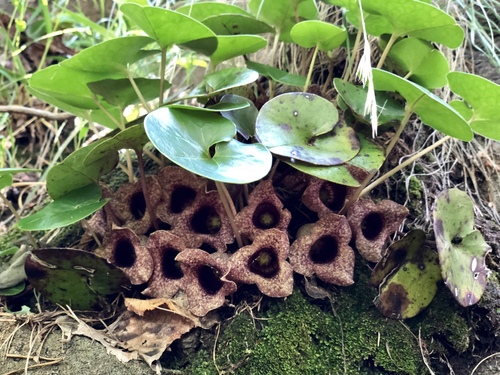
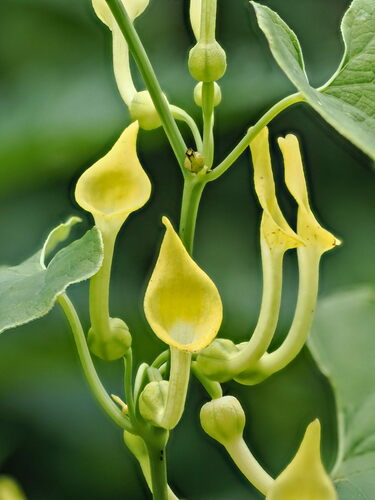
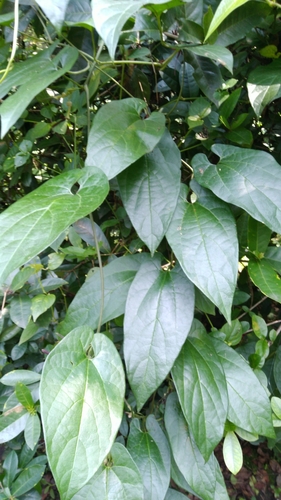
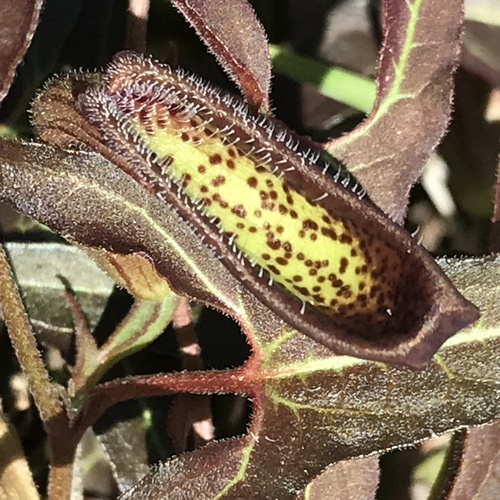
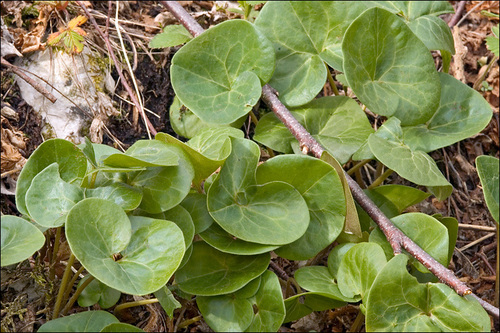
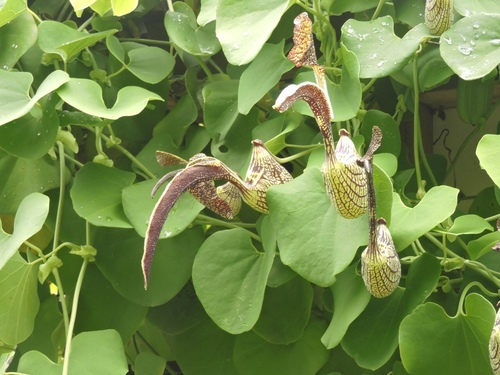
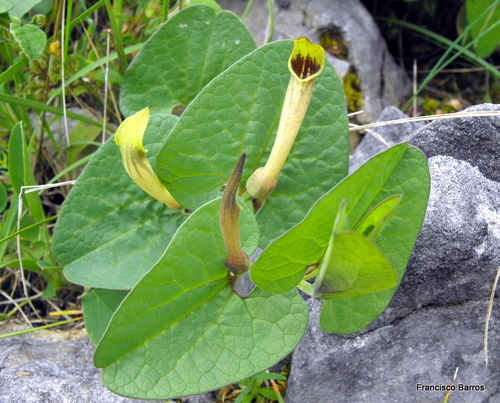
Aristolochia paucinervis Pomel is a perennial climbing vine geophyte that grows up to 0.5 meters tall in forest understories. It has a tuber that acts as a storage organ for the plant. Its leaves are simple, smooth, and broad, measuring 3 to 5 centimeters wide, with a triangular-oval blade shape and palmate veins. Its flowers are shaped like a saxophone, and come in two distinct phenotypes: yellow-white and brown-purple. Flowers are protogynous, meaning male and female reproductive organs develop at different times to prevent self-fertilization. Each flower has a tube-shaped perianth derived from a modified calyx. The perianth forms a reproductive structure called the gynostemium, which holds fused styles, stigmata, and anthers. On average, each flower produces around 2100 pollen grains and 42 ovules.
This species is widely distributed across the western Mediterranean, including Madeira and the Canary Islands of Macaronesia, Morocco, most of Portugal, primarily southern Spain (the Iberian Peninsula), the Balearic Islands, southern France, and a small part of Algeria; it is thought to be extinct in Tunisia. It grows at elevations between 500 and 2500 meters. Habitats include sandy and stony pastures, meadows, rocky cliffs, scrub, woodland clearings, cultivated fields where it occurs as a crop weed, woody grassy mountains, and Mediterranean forest. It prefers moist humid to dry substrates, including stony, clay, and sandy soils that are relatively poor with a basic pH.
Aristolochia paucinervis is pollinated by small flies (Diptera). It exudes a strong scent to attract flies into its tube-shaped perianth. Internal hairs trap the flies inside for a period of time. When the anthers mature, pollen is deposited onto the fly, then the hairs inside the perianth tube wither to let the insect escape to pollinate another flower. This is a deceptive pollination mechanism because the pollinators are saprophagous (they feed on decaying matter) and do not feed on nectar or pollen produced by the plant.
There are few reports of acute poisoning in humans or animals from this species, but all plants in the Aristolochiaceae family are considered dangerous when consumed over long periods, as their roots contain aristolochic acids (AAs). AAs have nephrotoxic effects that cause renal damage. When taken internally, AAs can be carcinogenic; long-term use of the rhizome can cause irreversible kidney damage, haematuria, and limb paralysis.
Aristolochia paucinervis has documented traditional and medicinal uses, particularly in Moroccan traditional medicine where it is locally called "Barraztam". Powdered root or rhizome mixed with salted smen can be applied topically to treat skin infections, injuries, and gas gangrene. When ingested with honey or salted butter, this mixture treats abdominal pain and upper respiratory tract infections. Ingesting dried powdered root is used to treat aortic palpitations, constipation, intestinal disorders, colic, and gas gangrene, and also works as a poison antidote for snakebites.
Methanol extract from the leaves of this species has anti-fungal properties, and is effective against pathogenic fungi that cause skin diseases and infections including tinea, dermatitis, and mycoses. Epidermophyton floccosum and Trichophyton violaceum are the most susceptible fungi to this extract, while Trichophyton mentagrophytes and Trichophyton rubrum are less sensitive to the tested fractions. The leaves also have antibacterial activity: in a study by Gadhi et al., the species showed activity against Clostridium perfringens, Clostridioides difficile, Enterococcus faecalis, Micrococcus luteus, and Bacillus subtilis, as measured by minimum inhibitory concentration. Dried and pulverized whole plant can be used externally to treat ringworm and wounds.
Plants in the Aristolochiaceae family contain aristolochic acids (AAs), a compound that has been used in herbal medicine dating back to the 5th century in China, and even earlier in Europe. AA present in this plant's roots stimulates white blood cell activity and speeds wound healing. AAs have also been used to treat tuberculosis, hepatitis, liver cirrhosis, and infantile pneumonia.