About Aristolochia littoralis Parodi
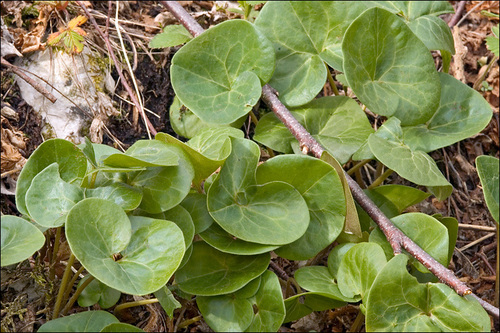
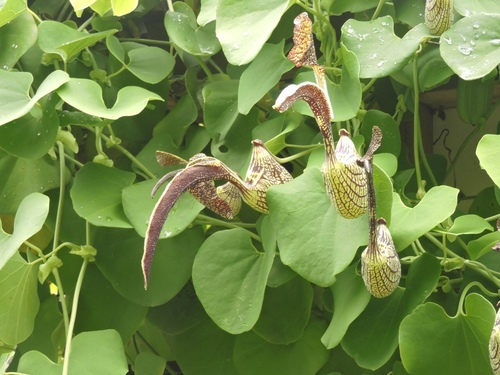
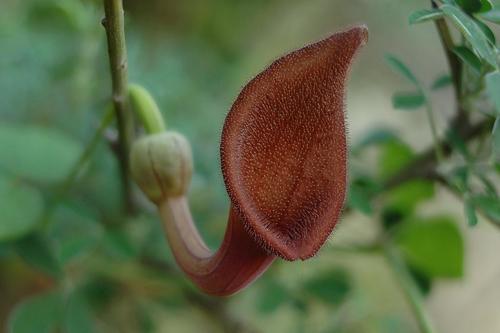
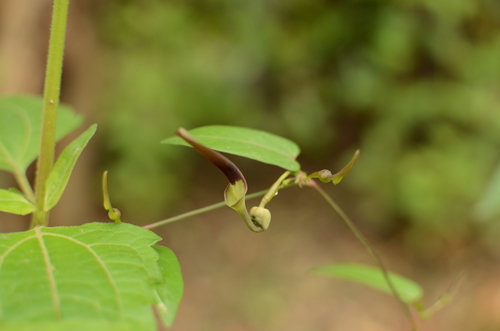
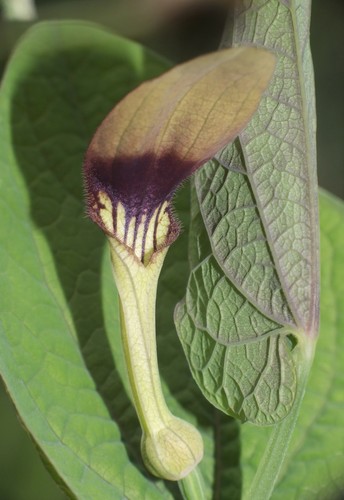
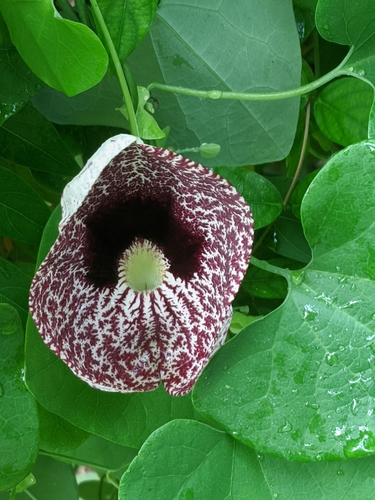
Aristolochia littoralis Parodi, commonly called Dutchman's pipe, is a climbing vine that grows to around 3–4.5 metres (9.8–14.8 ft) in length. Its slender stems are woody, while its leaves are bright green, heart-shaped, stem-clasping, 7–9 centimetres (2.8–3.5 in) long, and 5–10 centimetres (2.0–3.9 in) wide, forming dense, attractive foliage. The flowers of this species are heart-shaped, greenish yellow with complex purplish-brown markings. These unusual flowers measure around 7–8 centimetres (2.8–3.1 in) long, grow singly in leaf axils, and resemble Sherlock Holmes's pipe, which gives the plant its common name. The entire inner surface of the flared flower mouth is purplish-brown. Its flowering season lasts throughout the entire summer. Flowers produce an unpleasant carrion-like odor that attracts flies, which act as the plant's pollinators. It produces numerous winged seeds held in dry dehiscent capsules that split open like small parachutes; the winged structure of the seeds lets them be easily dispersed by wind. Plants in the related genus Pararistolochia differ from this species by having fleshy, moist fruit that does not split open. Aristolochia littoralis contains aristolochic acid, a toxic alkaloid. This vining species is native to southern and western South America. In South America it occurs in Brazil, specifically in the states of Ceara, Mato Grosso, Mato Grosso do Sul, Minas Gerais, Parana, Rio de Janeiro, Rondonia, Santa Catarina, and São Paulo; in Argentina, in the provinces of Corrientes, Entre Rios, Jujuy, Misiones, and Santa Fe; in Paraguay, in the departments of Amambay, Central, Concepcion, Cordillera, Paraguari, and San Pedro; and additionally in Bolivia, Colombia, Ecuador, and Peru. It is an invasive species in Australia and the southern United States. In Australia, it is fatal to the caterpillars of two butterfly species: the Cairns birdwing (Ornithoptera euphorion) and the threatened Richmond birdwing (O. richmondia), and it threatens to displace the butterflies' correct host plant, Aristolochia tagala. Aristolochia littoralis grows best in acid to neutral soils with a pH between 5.5 and 7.0, average moisture levels, and partial sun to partial shade. It can be found at elevations from 0 to around 1,150 metres (0–3,773 ft). This subtropical plant needs a minimum temperature of 7°C (45°F), so it is grown under glass in temperate regions. It has been awarded the Royal Horticultural Society's Award of Garden Merit.